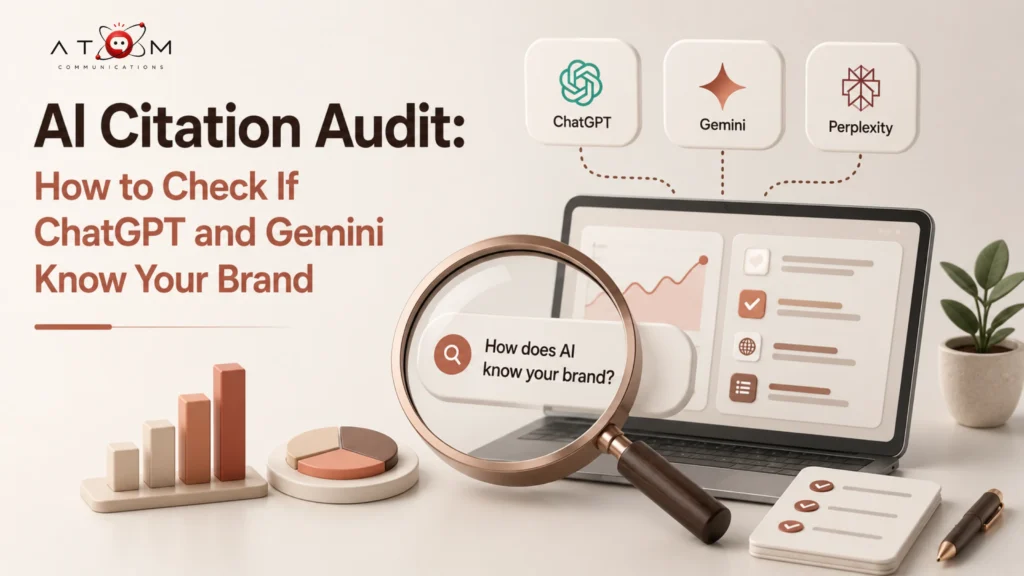
AI Citation Audit: How to Check If ChatGPT and Gemini Know Your Brand
SEO, AEO, and GEO get used interchangeably — but they optimize for three different buying moments. Here’s the real breakdown, and why early-stage B2B, fintech, and HR tech companies can’t treat GEO as optional in 2026.
What Google Ranking Actually Requires
Ensure Mobile-First Optimization
Local SEO Optimization
- Key takeaways
- AI visibility needs to be measured before it can be improved.
- Check both brand presence and accuracy across ChatGPT, Gemini and Perplexity.
- Trace the sources AI platforms use to understand where your brand information comes from.
- Benchmark competitors to identify gaps in AI-generated recommendations.
- Track AI visibility over time because model responses and source coverage can change.
- Third-party credibility matters when building a stronger, more consistent brand footprint across AI search.
Most founders have never typed their own company’s name into ChatGPT and asked what it knows. That’s worth doing today, before you build any AI visibility strategy — because you can’t fix a gap you haven’t measured.
Here’s what an actual audit looks like, and what the results usually reveal.
Step One: Ask the Direct Question
Open ChatGPT, Perplexity, and Gemini separately and ask each the same simple question: “What does [your company] do?” Then ask a category question without naming yourself: “What are the best [your category] platforms in India?”
The gap between these two answers tells you almost everything. If the direct question returns accurate, specific information, your brand has some footprint in the model’s training or retrieval layer. If the category question never surfaces your name — even though your product genuinely competes — you have a visibility problem, not a product problem.
Most early-stage B2B founders run this test for the first time during an audit and are surprised twice: once by how little the model knows, and again by which competitor it names instead.
Talk to an AI Marketing Expert to Scale Faster and Smarter
Step Two: Check for Accuracy, Not Just Presence
Being mentioned isn’t the same as being represented correctly. Models sometimes cite outdated information — an old company description, a previous funding round, a product feature you’ve since deprecated. This happens when the model’s most recent trusted source is stale, and nothing more current and credible has replaced it in the citation pool.
An audit should flag not just absence, but inaccuracy. A wrong description circulating in AI answers is arguably worse than no description at all, because it’s actively shaping how prospects understand you before they ever speak to your team.
Step Three: Trace the Source
Where possible — Perplexity is the most transparent here — check which sources the model cites for its answer. This is the most revealing part of the audit. You’ll often find the model pulling from a single outdated press release, a directory listing, or worse, a competitor comparison page that mentions you only in passing.
This tells you exactly what to fix. If the model’s only source is a two-year-old Crunchbase-style listing, that’s the credibility gap. The fix isn’t a new landing page — it’s fresh, credible third-party coverage that gives the model something more current and more authoritative to draw from.
Step Four: Benchmark Against Competitors
Run the same three questions for your two or three closest competitors. This isn’t about vanity comparison — it’s about understanding share of voice in the exact moment a prospect is asking an AI model to make a recommendation. If a competitor with a comparable product is being named and you’re not, the gap is almost always a media coverage gap, not a product gap. Founders assume the model is being objective about product quality. Often, it’s just reflecting whoever has more credible citations.
Step Five: Track It Over Time
AI visibility isn’t a one-time check. Model outputs shift as new sources get indexed and older ones lose relative weight. A quarterly audit — same questions, same format, tracked over time — turns this into a measurable input rather than a one-off curiosity. It’s the closest equivalent GEO has to a rank-tracking report in traditional SEO.
What the Audit Usually Reveals
Across most Series A/B companies we’ve looked at this way, the pattern repeats: strong product, competent website, reasonable SEO — and almost no credible third-party validation feeding AI models. The company exists confidently on its own channels and barely exists anywhere a model would trust as a source.
That’s a fixable gap, but not with more owned content. It requires the same lever that’s always built durable credibility — real coverage in outlets with editorial weight, consistent founder-led narrative, and enough independent corroboration that a model has a reason to treat your brand as fact rather than noise.
This is precisely why we built a Signal Audit at AtomComm — a structured way to run this diagnostic properly, trace the sourcing, and build a plan from what the audit actually shows, rather than guessing at what AI models might respond to.
For founders serious about the next phase of visibility, the audit isn’t optional groundwork. It’s the only way to know if you’re building a GEO strategy on real data or on assumption — and assumption is an expensive place to start.
Book a Free AI Marketing Strategy Consultation
Proof & Outcomes
An AI Citation Audit turns an unclear visibility problem into something you can actually evaluate.
See whether AI platforms recognize and mention your company for relevant category and recommendation queries.
Identify outdated, incomplete, or incorrect descriptions of your company, products, leadership, or positioning.
FAQs
An AI Citation Audit is a structured review of how AI platforms such as ChatGPT, Gemini and Perplexity understand, describe, cite and recommend a brand.
AI platforms are increasingly being used for research and recommendations. Checking what they know can reveal whether your brand information is accurate, incomplete, outdated, or missing altogether.
Start by asking ChatGPT a direct question such as “What does [company name] do?” Then ask category-based questions without mentioning your company and compare the results.
Yes. Different AI platforms can produce different answers and rely on different sources. Checking multiple platforms gives you a broader view of your brand's AI visibility.
Book a Free PR Strategy Session
Tell us a bit about your brand and goals. We’ll share a tailored press plan and timeline.