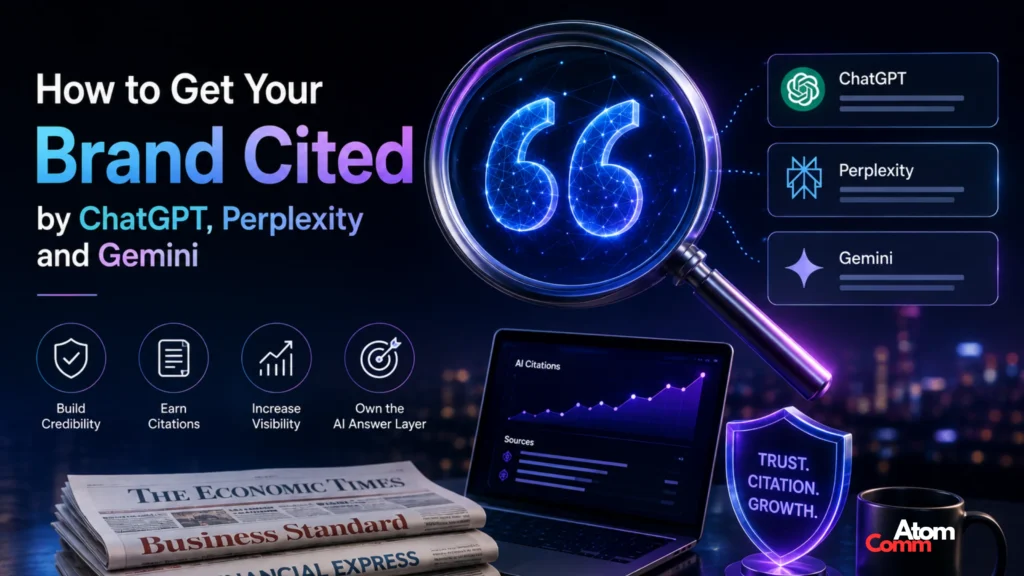
How to Get Your Brand Cited by ChatGPT, Perplexity and Gemini
A strategic framework for Indian brands to harness AI’s efficiency and scale while preserving the authentic brand voice, cultural nuance, and human connection that builds customer trust — covering content creation, customer service, social media, and the critical balance between automation and authenticity.
What Google Ranking Actually Requires
Ensure Mobile-First Optimization
Local SEO Optimization
- Key takeaways
- 67% of Indian consumers can detect generic AI-generated content and report lower trust in brands using it obviously
- AI works best as augmentation, not replacement — human-AI collaboration outperforms pure AI or pure human
- Brand voice guidelines are 10x more critical when using AI to maintain consistency across scaled content
- Cultural context is AI’s biggest gap — Indian regional nuances require human oversight even with advanced models
- Transparency about AI use builds trust — 58% of Indian consumers respect brands that acknowledge AI assistance
- Customer service AI must escalate to humans within 2-3 exchanges or satisfaction drops 45%
- AI-generated content requires human editing — the 70/30 rule (AI drafts 70%, human refines 30%) works best
- Testing AI content with real customers before broad deployment prevents authenticity disasters
- Founder voice cannot be fully AI-generated — audiences detect and reject inauthentic leadership communication
- Authentic brand storytelling still requires human creativity — AI handles execution, not emotional narrative
Ask ChatGPT to recommend a fintech compliance platform in India, and it will name two or three. Ask Perplexity the same question, and you’ll get citations — actual sources the model pulled from to build that answer. Your brand is either in that pool of sources, or it’s competing for a market that no longer knows it exists.
This is the practical reality behind AI citation building, and it operates on rules most founders haven’t reverse-engineered yet.
Citations Aren't Rankings — They're Trust Signals
Google ranking rewarded relevance and backlink volume. AI citation works differently. These models aren’t ordering results — they’re deciding, sentence by sentence, which sources are reliable enough to draw from when constructing an answer.
That means the bar isn’t “can this page be found.” It’s “does this source carry enough credibility that the model treats it as ground truth.” A single paragraph in Economic Times or Financial Express carries more citation weight than volumes of self-published content, because these models are trained to treat established, editorially-vetted publications as higher-trust sources.
Talk to an AI Marketing Expert to Scale Faster and Smarter
What Actually Gets Cited
Three patterns show up consistently across brands that do appear in AI-generated answers.
Third-party validation, not self-description. Language models are skeptical of a company describing itself. They weight external sources — journalism, analyst commentary, structured data — far more heavily than owned content. A founder’s LinkedIn post saying “we’re the leading X” does nothing for citation. A Moneycontrol or Business Standard feature saying the same thing, sourced from an actual journalist, does.
Specificity over adjectives. Models extract facts, not marketing language. “Processes claims 40% faster” gets cited. “Industry-leading claims processing” doesn’t, because there’s nothing factual to extract. Coverage written with concrete detail — numbers, mechanisms, named use cases — is simply more useful for a model to quote.
Repetition across independent sources. A single mention rarely earns a citation. Consistent, corroborated mentions across multiple credible outlets — a press release picked up by PTI, followed by a founder interview in CNBC-TV18, followed by a bylined piece in ET Edge Insights — build the kind of cross-source confirmation these models look for before treating a fact as reliable.
The Indian Context Makes This More Urgent, Not Less
Global AI models are trained heavily on English-language, high-authority sources — and Indian Tier-1 business media (Economic Times, LiveMint, Financial Express, Moneycontrol) increasingly features in that training and retrieval pool. That’s an advantage Indian B2B founders haven’t fully exploited yet. A Series A fintech or HR tech company that secures real coverage in these outlets today is building citation equity most competitors are ignoring, because most PR strategies in India are still optimized for Google indexing, not AI retrieval.
What Doesn't Work
Press release blasts to fifty aggregator sites don’t move the needle. Low-authority syndication sites aren’t sources these models weight meaningfully, and volume without credibility just adds noise. Similarly, keyword-stuffed content built for old-SEO logic tends to read as unreliable to models trained to detect promotional language — the opposite of what you want when the goal is being treated as a trustworthy source.
Building a Citation-Ready Footprint
The practical sequence looks like this: secure coverage in outlets with genuine editorial standards, ensure the coverage states facts plainly rather than in marketing language, get the same core narrative validated across multiple independent publications, and keep founder-attributed commentary consistent across every placement so models can associate expertise with a real, named person rather than a faceless company.
This is closer to traditional earned media discipline than growth-hacking — which is exactly the point. The tactics that build durable AI citation are the same ones that have always built durable reputation: real coverage, real credibility, said consistently, by real journalists.
At AtomComm, this is the lens we build every campaign through — not “how do we get a press release published,” but “does this coverage give AI models a reason to trust and cite this brand.” That distinction is increasingly the difference between a founder who shows up when their category is searched, and one who doesn’t.
The founders investing in this now — before every competitor catches up — are the ones who’ll own the AI answer layer of their category by the time it matters.
Book a Free AI Marketing Strategy Consultation
Proof & Outcomes
58% of Indian consumers prefer brands that acknowledge AI assistance versus those that hide it
Customer satisfaction remains 90%+ when AI handles routine tasks but escalates complex issues quickly
Brands using AI with human oversight see 40% cost reduction without significant engagement drops
FAQs
Test it with real customers before broad deployment. Send AI-generated drafts to 10-15 loyal customers and ask: "Does this sound like us?" If majority say no, your AI prompts need refinement. Also compare engagement metrics (comments, shares, saves) between AI-assisted and purely human content.
Only as a drafting assistant, not a replacement. The founder should outline their perspective, AI can help structure and polish, but the core ideas and voice must be authentically theirs. Audiences follow founders for unique insights, not polished corporate speak.
Yes, absolutely. Be transparent upfront. Customers appreciate honesty and understand AI can handle routine questions efficiently. They resent discovering they have been talking to AI when they thought it was human. Transparency builds trust; deception destroys it.
Create regional content guidelines covering language use, cultural references, and local contexts for each major market. Have humans from those regions review all AI-generated content before deployment. AI can scale, but humans provide cultural quality control.
Book a Free PR Strategy Session
Tell us a bit about your brand and goals. We’ll share a tailored press plan and timeline.