GEO vs SEO vs AEO: What B2B Founders Need to Know in 2026
SEO, AEO, and GEO get used interchangeably — but they optimize for three different buying moments. Here’s the real breakdown, and why early-stage B2B, fintech, and HR tech companies can’t treat GEO as optional in 2026.
What Google Ranking Actually Requires
Ensure Mobile-First Optimization
Local SEO Optimization
- Key takeaways
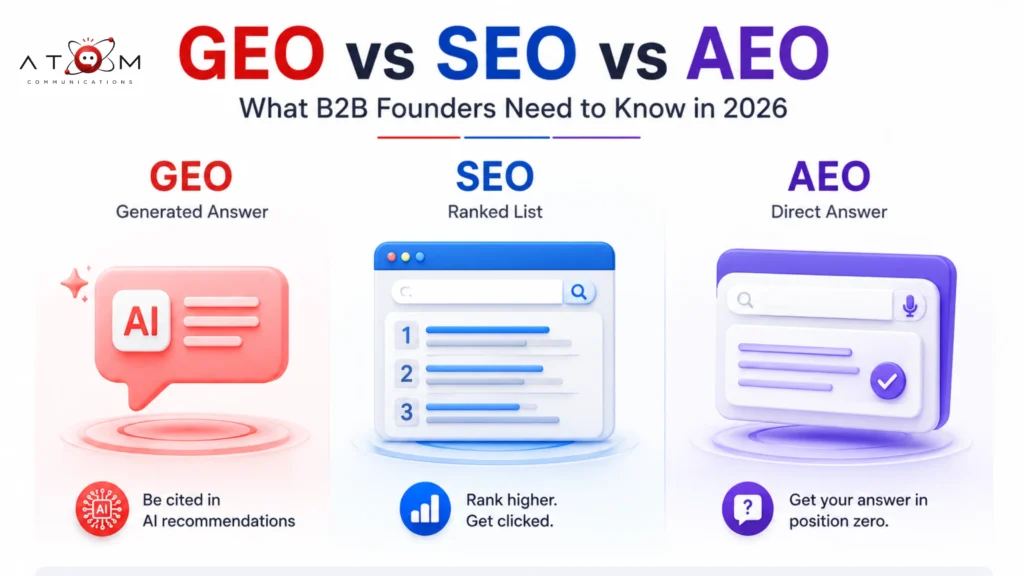
- SEO targets the ranked list — keywords, backlinks, and page structure for traditional search.
- AEO targets the direct answer — featured snippets, schema, and “position zero” formatting.
- GEO targets the AI-generated response — earned media, third-party validation, and citation-worthy coverage that LLMs trust.
- GEO behaves more like PR than technical SEO — you can’t “optimize” your way in with a plugin or schema tag.
- Early-stage companies start at a structural disadvantage on GEO since they lack the years of indexed coverage larger brands have.
- The three disciplines are layered, not competing — founders should invest in all three, not swap one for another.
Every founder building a marketing plan in 2026 is running into the same confusing acronym soup — SEO, GEO, AEO — often used interchangeably by agencies that haven’t fully worked out the distinctions themselves. That confusion is expensive. Each discipline optimizes for a different surface, a different algorithm logic, and increasingly, a different buying moment.
Here’s the actual breakdown — and why founders need to stop treating these as one line item in a marketing budget.
SEO: Optimizing for the Ranked List
Search Engine Optimization is the discipline you already know. It’s built for Google’s index — keyword targeting, backlink authority, page speed, meta structure — all oriented toward earning a position in a ranked list of ten blue links. The buyer sees multiple options, compares, and clicks.
SEO still matters. Most B2B buying research still touches a traditional search engine at some point. But the assumption underneath SEO — that the user will see a list and choose — is exactly what’s breaking down.
Talk to an AI Marketing Expert to Scale Faster and Smarter
AEO: Optimizing for the Direct Answer
Answer Engine Optimization emerged with featured snippets, voice search, and “position zero” — the single boxed answer Google gives before any ranked results appear. AEO is about structuring content so a search engine can lift a clean, direct answer: FAQs, definitions, step-by-step formatting, schema markup.
AEO is a bridge discipline. It taught the market to think in terms of “will this content get pulled into a direct answer” rather than “will this content rank.” That shift in thinking is precisely what generative AI has taken to its logical extreme.
GEO: Optimizing for the Generated Answer
Generative Engine Optimization is built for a fundamentally different environment: ChatGPT, Perplexity, Gemini, and AI Overviews, where there’s no list and often no single snippet — there’s a synthesized response drawing from multiple sources the model trusts.
GEO isn’t about keyword density or schema tags. It’s about whether your brand has enough credible, third-party validation — real coverage, real citations, a consistent factual footprint — that a language model treats you as a reliable source to draw from when it constructs an answer.
This is the critical difference founders miss: SEO and AEO are technical, on-page disciplines. GEO is closer to earned media and reputation building. You don’t “optimize” your way into an AI model’s trust with a plugin. You build it the way PR has always built credibility — through coverage in outlets the model already trusts.
Why This Matters More for Series A/B Companies
Larger, more established brands have decades of indexed content, analyst coverage, and Wikipedia presence feeding every one of these layers. Early-stage B2B companies — SaaS, fintech AI, HR tech — are starting from near zero on the GEO layer specifically, even if their SEO is solid.
That’s a structural problem, not a content problem. You can’t blog your way into AI citation. You need the kind of third-party validation — Tier-1 media coverage, founder-led bylines, consistent narrative across independent sources — that these models are actually trained to weight.
How the Three Work Together
These aren’t competing strategies — they’re layered:
SEO gets your website found when someone still searches traditionally. AEO gets your content pulled into direct-answer boxes when the query is specific enough. GEO determines whether your brand exists at all in the world of AI-generated recommendations — arguably the layer with the least competition right now, because most companies, including most agencies, haven’t built for it yet.
For a founder deciding where to invest limited marketing budget in 2026, the honest answer is: don’t abandon SEO, but stop treating GEO as optional or as something a technical SEO retainer will solve. It won’t. It requires the same discipline that’s always built brand credibility — real media relationships, real coverage, real consistency — applied with an understanding of how these newer systems actually consume and trust information.
At AtomComm, this is the framework we build client strategy around — not SEO instead of GEO, or GEO instead of PR, but all three working as one coherent visibility system, because that’s how the buyer’s actual search behavior works now.
The founders who separate these disciplines cleanly, and invest in each deliberately, are the ones building visibility that survives whatever search looks like next.
Book a Free AI Marketing Strategy Consultation
Proof & Outcomes
Framework applied across AtomComm's client strategy: SEO + AEO + GEO run as one coherent visibility system rather than siloed line items.
Positions GEO as the least contested channel right now — most companies and agencies haven't built for it yet, which is where an early mover gets outsized share of voice.
Directly ties into AtomComm's Signal Audit deliverable (AI discoverability scored against named competitors across ChatGPT, Perplexity, and Gemini), giving founders a baseline instead of guesswork.
FAQs
SEO optimizes for ranking in a list of search results. AEO optimizes for being pulled into a single direct-answer box. GEO optimizes for being cited as a trusted source inside an AI-generated response from tools like ChatGPT or Perplexity.
No. SEO and AEO are on-page, technical disciplines. GEO is closer to PR and reputation building — it depends on third-party validation and consistent coverage across sources the AI model already trusts, not keyword or schema optimization.
Larger, established brands have years of indexed content, analyst coverage, and Wikipedia presence feeding AI training data. Series A/B companies typically start at or near zero on that front, even with strong SEO.
No — the article frames SEO, AEO, and GEO as layered, not competing. SEO captures traditional search traffic, AEO captures direct-answer queries, and GEO determines whether a brand exists at all in AI-generated recommendations.
Book a Free PR Strategy Session
Tell us a bit about your brand and goals. We’ll share a tailored press plan and timeline.