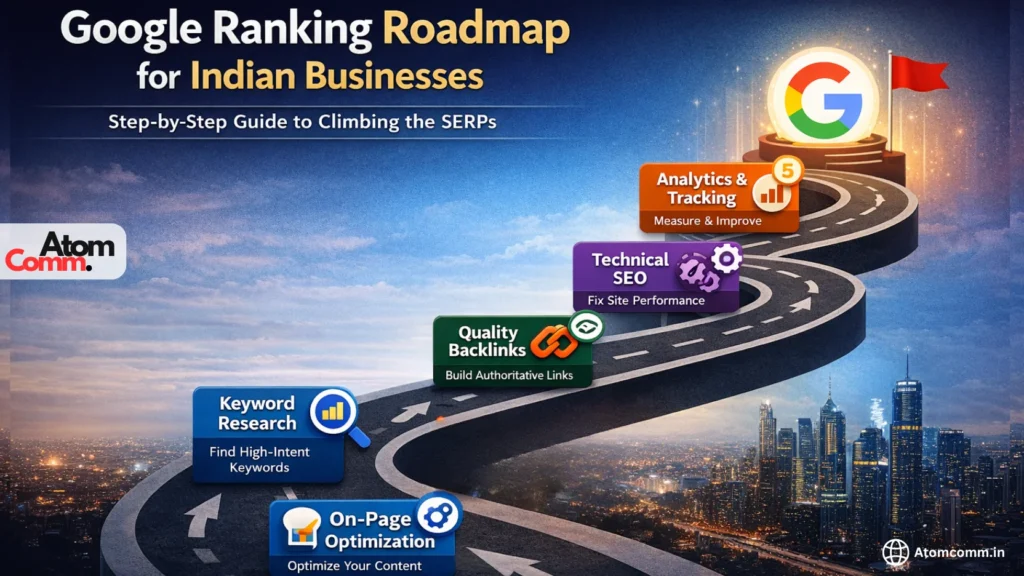
Google Ranking Roadmap for Indian Businesses (Step-by-Step)
A comprehensive, action-oriented roadmap for Indian businesses to achieve Google rankings — covering keyword research, technical foundations, content optimization, authority building, and performance tracking with India-specific strategies.
What Google Ranking Actually Requires
Ensure Mobile-First Optimization
Local SEO Optimization
- Key takeaways
- Google ranking requires a coordinated system, not isolated tactics
- Indian businesses must optimize for regional search patterns — Hindi, Tamil, Telugu queries are growing faster than English
- Technical SEO foundation comes before content creation — a slow, broken site cannot rank
- E-E-A-T signals (Experience, Expertise, Authoritativeness, Trustworthiness) determine competitive rankings in 2026
- Local SEO drives 46% of Google searches in India — ignoring location optimization leaves revenue on the table
- Search intent mapping prevents wasted effort — ranking for the wrong intent doesn’t convert
- Quality backlinks outweigh quantity exponentially — relevance and authority matter most
- Content refresh strategy often beats new publishing — updating existing content delivers faster gains
- Mobile-first indexing is non-negotiable — Google ranks based on mobile versions only
- Continuous tracking and optimization separate page 1 from page 3 — ranking is never finished
Why Most Indian Businesses Fail to Rank on Google
Every day, thousands of Indian businesses publish content, build websites, and hope Google will notice.
Most never break past page three.
The problem is not effort. It is not budget. It is not even competition.
The problem is approach.
Most Indian businesses treat SEO as a checklist: write blogs, add keywords, submit to directories, wait for rankings. When nothing happens after three months, they conclude SEO does not work or only works for large brands with massive budgets.
The reality is different.
Google ranking requires a roadmap — a coordinated system where technical foundation, content strategy, authority building, and continuous optimization work together. Skipping steps or executing them out of order produces weak results.
In 2026, the Indian businesses ranking consistently on Google are not guessing. They are following a proven sequence.
This guide breaks down that sequence step by step.
What Google Ranking Actually Requires
Before diving into the roadmap, understand what Google evaluates when deciding which pages to rank.
Google’s algorithm considers over 200 ranking factors, but they cluster into five core pillars:
1. Technical Foundation
Can Google crawl, index, and render your site properly? Is it fast? Is it mobile-friendly? Does it have clear structure?
2. Content Relevance
Does your content answer the searcher’s query comprehensively? Does it align with search intent? Is it original and valuable?
3. Authority & Trust
Is your website recognized as credible in your industry? Do authoritative sites link to you? Do users trust your content?
4. User Experience
Do visitors stay on your site? Do they click through to other pages? Or do they immediately return to search results?
5. Local Relevance (for location-based businesses)
Are you optimized for location searches? Is your Google Business Profile complete? Do you have local citations?
Every tactic in the roadmap below strengthens one or more of these pillars.
The 6-Phase Google Ranking Roadmap for Indian Businesses
Talk to an SEO Expert and Build a Content Strategy That Ranks
Phase 1: Foundation & Technical SEO (Weeks 1-2)
You cannot build rankings on a broken foundation. Phase 1 ensures Google can crawl, index, and understand your website properly.
Step 1.1: Audit Site Speed
Google prioritizes fast sites. In India, where many users browse on slower mobile networks, speed is critical.
Action items:
- Run your site through Google PageSpeed Insights
- Aim for a score of 80+ on mobile
- Compress images using TinyPNG or ImageOptim
- Enable browser caching
- Use a CDN like Cloudflare
- Minimize CSS and JavaScript files
Target: Page load time under 3 seconds on 4G networks.
Step 1.2: Ensure Mobile-First Optimization
Google uses the mobile version of your site for all ranking decisions. If your mobile experience is poor, you will not rank — regardless of desktop quality.
Action items:
- Test mobile-friendliness using Google’s Mobile-Friendly Test
- Ensure text is readable without zooming
- Make buttons and links large enough to tap easily
- Avoid pop-ups that cover content on mobile
- Use responsive design, not separate mobile URLs
Step 1.3: Fix Crawlability Issues
If Google cannot crawl your site properly, your content will never rank.
Action items:
- Submit an XML sitemap to Google Search Console
- Check for crawl errors in Search Console → Coverage report
- Fix broken internal links (use Screaming Frog or Ahrefs)
- Ensure robots.txt is not blocking important pages
- Add structured data (schema markup) for key pages
Step 1.4: Optimize Site Architecture
A clear site structure helps both users and Google understand your content.
Action items:
- Organize content into logical categories
- Ensure every page is reachable within 3 clicks from homepage
- Use breadcrumb navigation
- Create internal linking between related pages
- Build a flat, shallow site hierarchy
Outcome of Phase 1: A technically sound website that Google can crawl, index, and rank without friction.
Phase 2: Keyword Research & Search Intent Mapping (Weeks 3-4)
Ranking for the wrong keywords wastes time and budget. Phase 2 ensures you target the right search queries with the right content.
Step 2.1: Build Your Core Keyword List
Start with broad industry terms, then expand into specific long-tail keywords.
Action items:
- Use Google Keyword Planner for India-specific search volume
- Mine “People Also Ask” and “Related Searches” on Google
- Check competitor keywords using Ahrefs or SEMrush
- Include regional language keywords (Hindi, Tamil, Telugu, Bengali, Marathi)
- Identify “near me” and city-specific variations for local businesses
Target: 50-100 keyword opportunities across different intent stages.
Step 2.2: Map Keywords to Search Intent
Not all keywords represent the same buyer stage. Mapping intent prevents content-audience mismatch.
Four intent types:
| Intent Type | User Goal | Example Keywords | Content Type |
|---|---|---|---|
| Informational | Learning and research | "what is digital marketing", "how to start business in India" | Blog posts, guides |
| Navigational | Finding a specific brand or website | "Flipkart customer service" | Homepage, brand pages |
| Commercial | Comparing products or services | "best CRM software India", "top SEO agencies Bangalore" | Comparisons, listicles |
| Transactional | Ready to take action or purchase | "hire SEO consultant Mumbai", "buy domain India" | Service and product pages |
Action items:
- Assign intent type to every keyword
- Plan content format based on intent
- Prioritize commercial and transactional keywords for business impact
Step 2.3: Analyze Competition & Ranking Difficulty
Not all keywords are equally achievable. Focus on low-hanging fruit first.
Action items:
- Check Domain Authority of top 10 ranking pages
- Analyze content depth and quality of ranking articles
- Identify keywords where competition is weak
- Target “medium difficulty” keywords (20-40 KD score) initially
- Save high-difficulty keywords for later phases
Outcome of Phase 2: A prioritized keyword list with clear intent mapping and realistic ranking targets.
Phase 3: Content Creation & On-Page Optimization (Weeks 5-10)
Content is what Google ranks. Phase 3 focuses on creating high-quality, optimized content aligned with search intent.
Step 3.1: Create Pillar Content First
Pillar pages are comprehensive guides that cover broad topics. Supporting cluster content links back to pillars, building topical authority.
Action items:
- Identify 3-5 core topics central to your business
- Create in-depth pillar pages (2,000-3,000 words minimum)
- Cover subtopics comprehensively
- Use clear heading structure (H1, H2, H3)
- Include original examples, data, or case studies
Example pillar topics for a B2B SaaS company:
- Complete Guide to CRM Software for Indian SMBs
- How to Scale Sales Operations in India
- B2B Marketing Strategies That Work in Indian Markets
Step 3.2: Build Supporting Cluster Content
Cluster articles target specific long-tail keywords and link back to pillar pages.
Action items:
- Create 5-10 cluster articles per pillar topic
- Target specific long-tail keywords
- Link cluster articles to pillar page using relevant anchor text
- Interlink cluster articles where relevant
- Maintain consistent depth and quality
Example cluster topics for CRM pillar:
- Top 10 CRM Features Indian Businesses Need
- CRM vs Spreadsheets: What’s Better for SMBs?
- How to Migrate from Excel to a CRM System
- Best CRM Software Under ₹10,000/Month
Step 3.3: Optimize On-Page SEO Elements
Even great content will not rank without proper optimization.
Action items for every page:
- Title Tag: Include primary keyword, keep under 60 characters
- Meta Description: Compelling summary with keyword, under 160 characters
- URL Structure: Short, descriptive, keyword-included
- Header Tags: Use H1 for title, H2/H3 for sections, include keywords naturally
- Image Alt Text: Describe images accurately, include keywords where relevant
- Internal Links: Link to 3-5 related pages within content
- External Links: Cite authoritative sources
- Schema Markup: Add structured data for articles, products, FAQs, local business
Step 3.4: Prioritize E-E-A-T Signals
Google’s E-E-A-T framework (Experience, Expertise, Authoritativeness, Trustworthiness) heavily influences rankings.
Action items:
- Add author bylines with credentials
- Include expert quotes or contributions
- Publish original research, case studies, or data
- Display trust signals (certifications, awards, client logos)
- Link to authoritative sources
- Keep content factually accurate and up-to-date
Outcome of Phase 3: A library of high-quality, optimized content covering your core topics comprehensively.
Phase 4: Authority Building & Link Acquisition (Weeks 11-20)
Backlinks remain Google’s strongest ranking signal. Phase 4 focuses on earning high-quality links from relevant, authoritative sites.
Step 4.1: Build Foundational Links
Start with low-hanging link opportunities that are easy to acquire.
Action items:
- Create and optimize Google Business Profile
- List business on relevant directories (Justdial, Sulekha, IndiaMART)
- Submit site to industry-specific directories
- Get listed on local chamber of commerce sites
- Claim profiles on review sites
Step 4.2: Execute Digital PR & Media Outreach
Earning media coverage creates high-authority backlinks and brand visibility.
Action items:
- Identify journalists covering your industry (YourStory, Economic Times, Business Standard)
- Create newsworthy story angles (funding, product launch, market data)
- Write and distribute press releases
- Offer expert commentary on trending industry topics
- Build relationships with relevant bloggers and podcasters
Step 4.3: Create Link-Worthy Assets
Content that naturally attracts links without outreach.
Action items:
- Publish original industry research or surveys
- Create comprehensive guides or resource libraries
- Develop free tools, calculators, or templates
- Design shareable infographics with data
- Produce case studies with measurable results
Step 4.4: Guest Posting & Contributor Opportunities
Writing for established sites in your industry earns backlinks and visibility.
Action items:
- Identify top blogs and publications in your industry
- Pitch unique, high-value article ideas
- Provide genuinely useful content
- Include 1-2 contextual backlinks to relevant pages
- Build relationships for ongoing opportunities
Step 4.5: Competitor Backlink Analysis
Find link opportunities by analyzing where competitors are getting links.
Action items:
- Use Ahrefs or SEMrush to analyze competitor backlink profiles
- Identify high-authority sites linking to competitors
- Reach out to those sites with better content or unique angles
- Replicate competitor link strategies that are working
Outcome of Phase 4: A growing backlink profile from relevant, authoritative sites that signals credibility to Google.
Talk to an SEO Expert and Build a Scalable Content Engine
Phase 5: Local SEO Optimization (For Location-Based Businesses)
46% of Google searches in India have local intent. Phase 5 ensures you capture location-based search traffic.
Step 5.1: Optimize Google Business Profile
Your Google Business Profile is critical for local visibility.
Action items:
- Complete every section: business name, address, phone, website, hours
- Choose accurate primary and secondary categories
- Add high-quality photos (exterior, interior, products, team)
- Collect and respond to customer reviews
- Post regular updates (offers, events, news)
- Add services/products with descriptions and pricing
Step 5.2: Build Local Citations
Consistent NAP (Name, Address, Phone) across the web strengthens local rankings.
Action items:
- List business on Justdial, Sulekha, IndiaMART, MouthShut
- Ensure NAP consistency across all listings
- Get listed on local directories and chamber sites
- Add location pages to your website if serving multiple cities
Step 5.3: Create Location-Specific Content
Content targeting city or neighborhood keywords improves local visibility.
Action items:
- Create city-specific service pages (e.g., “SEO Services in Bangalore”)
- Write blog posts about local events, news, or trends
- Include local landmarks and references in content
- Embed Google Maps on contact and location pages
Step 5.4: Earn Local Backlinks
Links from local websites signal relevance to Google for local searches.
Action items:
- Sponsor local events or organizations
- Partner with local businesses for co-marketing
- Get featured in local news publications
- Join local business associations
Outcome of Phase 5: Dominant visibility in location-based searches, driving foot traffic and local leads.
Phase 6: Performance Tracking & Continuous Optimization (Ongoing)
Ranking is not a destination. It requires continuous monitoring, testing, and refinement.
Step 6.1: Set Up Tracking Infrastructure
You cannot improve what you do not measure.
Action items:
- Install Google Analytics 4 (GA4)
- Set up Google Search Console
- Connect both to your domain
- Set up conversion tracking for key actions
- Create custom dashboards for SEO metrics
Step 6.2: Monitor Keyword Rankings
Track progress on target keywords weekly or monthly.
Action items:
- Use tools like Ahrefs, SEMrush, or SE Ranking
- Track top 50-100 keywords
- Monitor ranking changes and trends
- Identify pages gaining or losing rankings
- Adjust content or strategy based on performance
Step 6.3: Analyze Traffic & User Behavior
Rankings mean nothing if they do not drive engaged traffic.
Action items:
- Track organic traffic growth in GA4
- Monitor bounce rate and time on page
- Identify high-exit pages (potential issues)
- Analyze which pages drive conversions
- Use heatmaps (Hotjar, Crazy Egg) to understand behavior
Step 6.4: Conduct Content Refresh Audits
Updating existing content often delivers faster ranking gains than publishing new content.
Action items:
- Identify content published 12+ months ago
- Check if rankings have declined
- Update outdated statistics, examples, or screenshots
- Add new sections covering recent developments
- Improve internal linking to newer content
- Re-optimize title tags and meta descriptions
Step 6.5: Quarterly Strategy Reviews
Step back quarterly to assess what is working and adjust strategy.
Action items:
- Review overall organic traffic trends
- Analyze top-performing content and replicate success
- Identify underperforming content and fix or redirect
- Assess backlink growth and quality
- Adjust keyword targeting based on performance data
- Set new goals and priorities for next quarter
Outcome of Phase 6: Continuous ranking improvement driven by data, not assumptions.
Common Mistakes Indian Businesses Make with SEO
Mistake 1: Expecting Fast Results
SEO takes 3-6 months to show meaningful results for medium-competition keywords. Brands that expect rankings in 30 days often quit too early.
Fix: Set realistic timelines. Focus on building systems, not chasing quick wins.
Mistake 2: Keyword Stuffing
Overusing keywords makes content unreadable and can trigger Google penalties.
Fix: Write for humans first. Use keywords naturally. Focus on topic coverage, not keyword density.
Mistake 3: Ignoring Regional Language Searches
Hindi, Tamil, Telugu, and other regional languages represent massive untapped search volume in India.
Fix: Create content in regional languages. Optimize for transliterated queries.
Mistake 4: No Mobile Optimization
Over 75% of Indian searches happen on mobile. Desktop-only optimization leaves most traffic on the table.
Fix: Adopt mobile-first design. Test on real devices across network speeds.
Mistake 5: Building Low-Quality Backlinks
Buying links from spammy sites damages rankings more than helping.
Fix: Focus on earning links from relevant, authoritative sites. Quality over quantity, always.
Mistake 6: Publishing Without Promotion
Content without distribution rarely ranks, regardless of quality.
Fix: Promote every piece through social media, email, PR outreach, and internal linking.
Talk to an SEO Expert to Drive Sustainable Organic Growth
Proof & Outcomes
Strategic targeting of medium-difficulty keywords delivers page 1 rankings within 5-7 months for most industries.
Search intent-aligned content attracts visitors closer to purchase decisions, improving conversion rates by 40-60%.
Quality link building and E-E-A-T optimization increases domain authority, making future ranking easier.
FAQs
For medium-difficulty keywords, expect 5-7 months to reach page 1 with consistent execution. Long-tail, low-competition keywords may rank in 2-3 months. High-competition, broad keywords can take 12+ months. Timeline depends on your domain authority, content quality, and competitive landscape.
Both. English captures metros, B2B audiences, and higher purchasing power segments. Regional languages (Hindi, Tamil, Telugu, Bengali, Marathi) unlock Tier-2 and Tier-3 markets where growth is accelerating. Start with English, then expand to the regional languages most relevant to your target markets.
For DIY execution, budget ₹5,000-₹10,000/month for tools (Ahrefs/SEMrush, hosting, CDN). For agency execution, expect ₹25,000-₹75,000/month depending on competition and scope. Enterprise SEO for highly competitive sectors can exceed ₹1,00,000/month.
In-house works if you have dedicated resources, technical expertise, and time. Agencies accelerate results through experience, established processes, and full-time focus. Most growing Indian businesses benefit from hybrid: agency for strategy and execution, in-house for content and brand knowledge.
Book a Free PR Strategy Session
Tell us a bit about your brand and goals. We’ll share a tailored press plan and timeline.