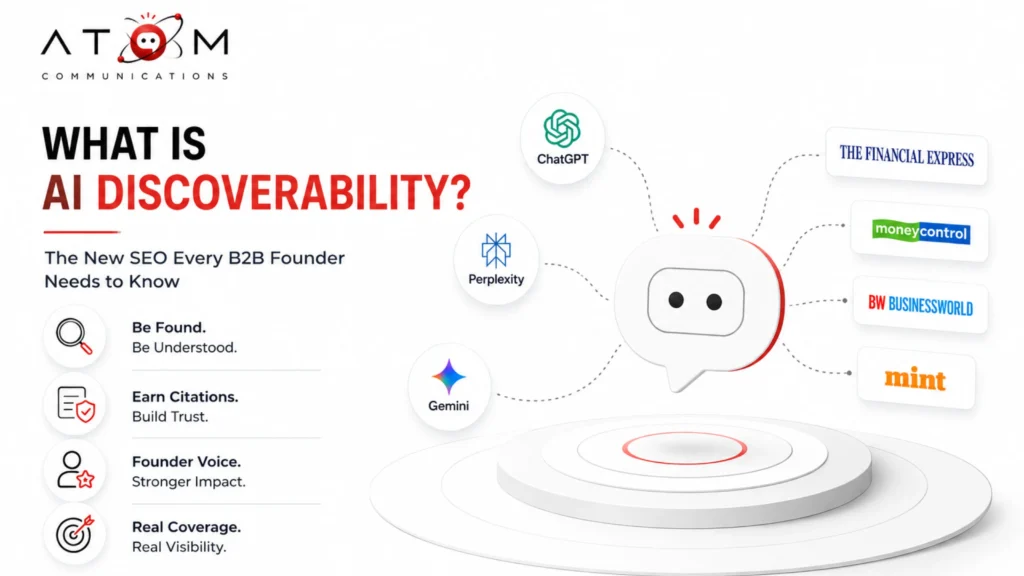
What Is AI Discoverability? The New SEO Every B2B Founder Needs to Know
A strategic framework for Indian brands to harness AI’s efficiency and scale while preserving the authentic brand voice, cultural nuance, and human connection that builds customer trust — covering content creation, customer service, social media, and the critical balance between automation and authenticity.
What Google Ranking Actually Requires
Ensure Mobile-First Optimization
Local SEO Optimization
- Key takeaways
- 67% of Indian consumers can detect generic AI-generated content and report lower trust in brands using it obviously
- AI works best as augmentation, not replacement — human-AI collaboration outperforms pure AI or pure human
- Brand voice guidelines are 10x more critical when using AI to maintain consistency across scaled content
- Cultural context is AI’s biggest gap — Indian regional nuances require human oversight even with advanced models
- Transparency about AI use builds trust — 58% of Indian consumers respect brands that acknowledge AI assistance
- Customer service AI must escalate to humans within 2-3 exchanges or satisfaction drops 45%
- AI-generated content requires human editing — the 70/30 rule (AI drafts 70%, human refines 30%) works best
- Testing AI content with real customers before broad deployment prevents authenticity disasters
- Founder voice cannot be fully AI-generated — audiences detect and reject inauthentic leadership communication
- Authentic brand storytelling still requires human creativity — AI handles execution, not emotional narrative
Search is no longer a page of blue links. When your prospect asks ChatGPT to recommend a fintech compliance tool, or asks Perplexity to compare HR tech platforms, there’s no scroll, no ten results, no meta description competing for a click. There’s an answer — and either your brand is in it, or it doesn’t exist.
This is the shift most Indian B2B founders haven’t priced in yet.
Google Optimized You. Now What?
For two decades, visibility meant ranking. You built backlinks, wrote keyword-dense content, chased Domain Authority, and hoped the algorithm rewarded you with a top-three spot. That playbook isn’t dead, but it’s no longer the whole game.
Generative AI models — ChatGPT, Perplexity, Gemini, Google’s AI Overviews — don’t return ranked lists. They synthesize an answer from what they’ve read, cited, and trust. If your brand hasn’t been mentioned credibly across the sources these models draw from, you’re invisible in the exact moment a buyer is closest to a decision.
That’s the discipline now called AI discoverability — or, more precisely, Generative Engine Optimization (GEO): the practice of structuring your brand’s presence so AI systems can find it, understand it, and cite it accurately.
Talk to an AI Marketing Expert to Scale Faster and Smarter
Why This Matters More for Series A/B Companies Than Anyone Else
Enterprise brands have decades of press coverage, Wikipedia entries, and analyst reports feeding these models. Early-stage B2B companies — SaaS, fintech AI, HR tech — don’t have that luxury. Your founder might be doing genuinely category-defining work, and an AI model still won’t know you exist, because nothing has been written, cited, or indexed about you in a way these systems trust.
This is the credibility gap that decides deals before your sales team ever gets on a call.
What Actually Builds AI Discoverability
GEO isn’t a plugin or a hack. It’s built the same way credibility has always been built — through earned, third-party validation — just optimized for how language models consume information.
A few things matter disproportionately:
Structured, factual clarity. AI models favor content that states what a company does, who it serves, and what problem it solves — without marketing fluff burying the facts.
Citation density across credible sources. A single feature in a Tier-1 publication carries more weight with these models than fifty LinkedIn posts. Coverage in outlets like Financial Express, Moneycontrol, or Business World doesn’t just build human trust — it builds machine trust, because these are sources AI models are trained to weight heavily.
Consistency of narrative. If your positioning shifts across every press mention, models struggle to form a coherent understanding of your brand. Consistency compounds; contradiction dilutes.
Founder authority. Bylined articles and interviews tied to a named founder — not a generic “spokesperson” — perform better in AI retrieval because models associate expertise with individuals, not faceless companies.
PR's New Job Description
This reframes public relations entirely. PR was always about earned credibility. What’s changed is the audience reading that credibility — increasingly, it’s not just a journalist’s editor or a human reader, but a language model deciding whether your brand belongs in its answer.
That means press releases, thought leadership, and media placements aren’t just reputation assets anymore. They’re training-adjacent signals that determine whether your company shows up when your buyer asks an AI a question instead of typing it into Google.
For founders, the practical takeaway is this: measure PR not just by impressions or backlinks, but by whether your brand’s story is coherent, citable, and present across the sources AI models actually pull from.
The Founders Who'll Win This Decade
The companies that show up in AI-generated answers three years from now are the ones building that footprint today — deliberately, consistently, with real coverage in real publications, not synthetic SEO tricks.
This is the exact gap AtomComm was built to close — treating AI discoverability as inseparable from earned media, not a separate service bolted onto traditional PR. For a founder building category leadership, the question isn’t whether to invest in visibility. It’s whether that visibility is built for the search behavior your buyers actually use now.
Because the buyers asking AI for recommendations aren’t going to scroll past you. They’re simply not going to know you exist.
Book a Free AI Marketing Strategy Consultation
Proof & Outcomes
58% of Indian consumers prefer brands that acknowledge AI assistance versus those that hide it
Customer satisfaction remains 90%+ when AI handles routine tasks but escalates complex issues quickly
Brands using AI with human oversight see 40% cost reduction without significant engagement drops
FAQs
Test it with real customers before broad deployment. Send AI-generated drafts to 10-15 loyal customers and ask: "Does this sound like us?" If majority say no, your AI prompts need refinement. Also compare engagement metrics (comments, shares, saves) between AI-assisted and purely human content.
Only as a drafting assistant, not a replacement. The founder should outline their perspective, AI can help structure and polish, but the core ideas and voice must be authentically theirs. Audiences follow founders for unique insights, not polished corporate speak.
Yes, absolutely. Be transparent upfront. Customers appreciate honesty and understand AI can handle routine questions efficiently. They resent discovering they have been talking to AI when they thought it was human. Transparency builds trust; deception destroys it.
Create regional content guidelines covering language use, cultural references, and local contexts for each major market. Have humans from those regions review all AI-generated content before deployment. AI can scale, but humans provide cultural quality control.
Book a Free PR Strategy Session
Tell us a bit about your brand and goals. We’ll share a tailored press plan and timeline.