Press Release SEO: Optimizing Announcements for Search and AI Together
SEO, AEO, and GEO get used interchangeably — but they optimize for three different buying moments. Here’s the real breakdown, and why early-stage B2B, fintech, and HR tech companies can’t treat GEO as optional in 2026.
What Google Ranking Actually Requires
Ensure Mobile-First Optimization
Local SEO Optimization
- Key takeaways
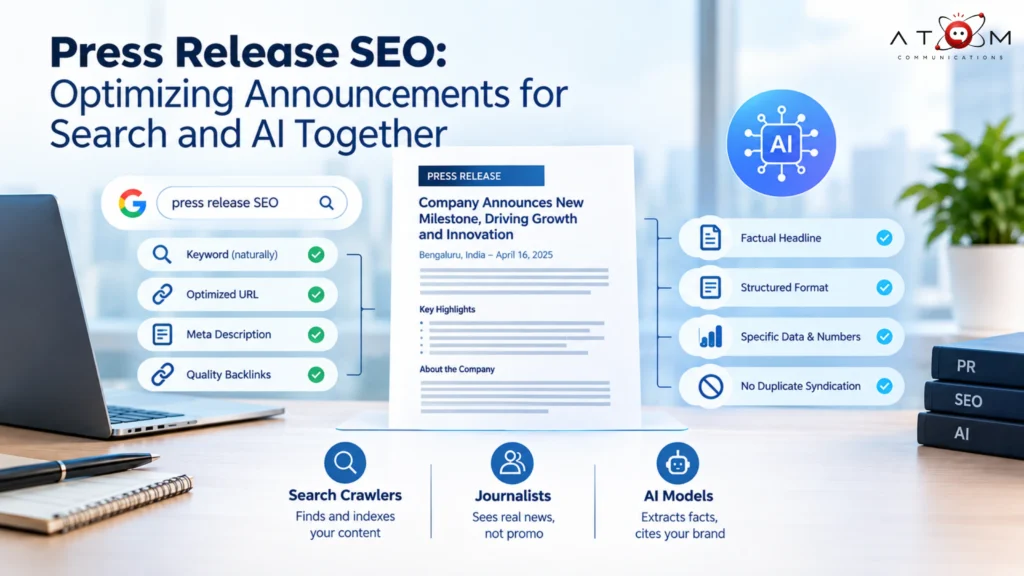
- Write for both search engines and AI systems. Modern press releases need to work for crawlers, journalists and AI retrieval.
- Use keywords naturally. Keyword stuffing can make a release less readable and less credible.
- Lead with factual news. A specific announcement is more valuable than a keyword-heavy headline.
- Use structured content. Clear sections, short paragraphs and logical formatting make information easier to process.
- Include verifiable details. Numbers, dates, names and measurable outcomes strengthen both search and AI visibility.
- Prioritize credible coverage over mass syndication. Independent coverage from authoritative publications can provide stronger signals than duplicate distribution.
For years, press release SEO meant one thing: stuff the keyword you wanted to rank for into the headline, repeat it twice in the body, add a few backlinks, and let Google do the rest. That approach is now actively counterproductive — not because keywords stopped mattering, but because there’s a second reader in the room, and it doesn’t respond to the same tricks.
Every release you publish today is being read by a search crawler and, increasingly, by a language model deciding whether to cite you. Optimizing for one without the other is half a strategy.
Where Traditional Press Release SEO Still Applies
Some fundamentals haven’t changed. A clear, descriptive headline that includes your core keyword naturally — not forced — still helps search visibility. A well-structured URL, a concise meta description, and internal links back to relevant pages on your site all remain useful signals for traditional search indexing.
Backlinks from the release still carry SEO value, particularly when the release is picked up by a domain with genuine authority rather than syndicated across low-quality aggregator sites. One contextual link from a Financial Express or Business Standard article referencing your company is worth considerably more than twenty links from generic wire syndication pages — both for search ranking and, as it turns out, for AI trust.
Talk to an AI Marketing Expert to Scale Faster and Smarter
Where the Old Playbook Breaks
Keyword density — repeating a phrase multiple times to signal relevance — is a liability now, not an asset. Language models are trained to recognize promotional, repetitive phrasing as a weaker signal of factual reliability. A release that reads like it was written for a crawler rather than a person tends to get treated with the same skepticism by both a journalist and a model evaluating source quality.
The same applies to vague SEO-friendly phrases like “best AI platform for enterprises” — language models don’t reward superlatives, they extract facts. A release optimized purely for keyword matching often ends up with less usable, less citable content than one written plainly.
What Optimizing for Both Actually Looks Like
The releases performing well across both search and AI retrieval share a few characteristics.
They lead with a specific, factual news hook rather than a keyword-loaded headline — the kind of sentence a journalist would actually write themselves, not one engineered for search intent. This satisfies both audiences: search engines still parse relevance well from natural language, and models extract facts more reliably from sentences that state something concrete.
They use structured formatting — clear subheadings, short paragraphs, defined sections for background and company information — which helps both traditional crawlers parse the page and AI systems segment information into retrievable chunks.
They include specific numbers, dates, and named details rather than generic descriptors, because both search engines and AI models weight verifiable facts more heavily than adjectives. “Reduced onboarding time by 60%” does more SEO and GEO work than “significantly improved onboarding,” even though the older SEO instinct might have been to keyword-stuff the second version instead.
They avoid duplicate syndication as a primary strategy. A release identical across two hundred domains creates a duplicate-content problem for search and a diluted-trust problem for AI citation — neither crawler nor model treats repeated content as multiple independent confirmations of anything.
The India-Specific Angle
For Indian B2B companies, this matters more given how concentrated Tier-1 business media coverage already is. A release that earns genuine pickup in Economic Times, LiveMint, or Moneycontrol — rather than pure wire syndication — does double duty: strong domain authority for SEO, and strong source credibility for AI citation, because these are exactly the outlets models are trained to weight heavily.
Book a Free AI Marketing Strategy Consultation
A Practical Checklist
Before publishing, a release should pass a simple test: does the headline state real news plainly, does the first paragraph contain a verifiable fact rather than a claim, is there at least one specific number or mechanism described, and would this read credibly if quoted directly by a model answering a question about your company. If a release only passes the old SEO checklist — keyword present, backlink included — it’s incomplete for 2026.
The Underlying Shift
Press release SEO used to be a technical exercise, separate from the substance of the writing. Increasingly, it’s inseparable from writing well and factually in the first place — because the two audiences that matter most, search crawlers and language models, are both, in their own way, rewarding clarity and penalizing promotional noise.
At AtomComm, every release is built against this dual standard from the first draft — not retrofitted with keywords afterward, but structured from the outset to hold up to a journalist’s judgment, a search engine’s crawler, and a model’s citation logic at the same time.
That’s no longer a nice-to-have layer on top of PR. It’s what a competent press release looks like now.
Proof & Outcomes
Natural keyword placement and clear topical information help search engines understand the purpose and subject of the release.
Short paragraphs, descriptive headings and factual writing make releases easier for journalists and audiences to scan.
Clear, structured and factual information gives AI systems more useful material when interpreting or retrieving information about a company.
FAQs
Press release SEO is the practice of optimizing a press release so search engines can understand its topic and relevance while keeping the content useful and credible for readers and journalists.
Use important keywords naturally where they make sense. Repeating the same keyword excessively can make the release sound unnatural and promotional.
It can be useful when the keyword naturally describes the news. However, the headline should prioritize news value and clarity rather than forcing an exact-match keyword.
They can provide value when a release earns genuine editorial pickup and contextual links from authoritative publications. Links from mass syndication should not be treated as equivalent to independent editorial links.
Book a Free PR Strategy Session
Tell us a bit about your brand and goals. We’ll share a tailored press plan and timeline.