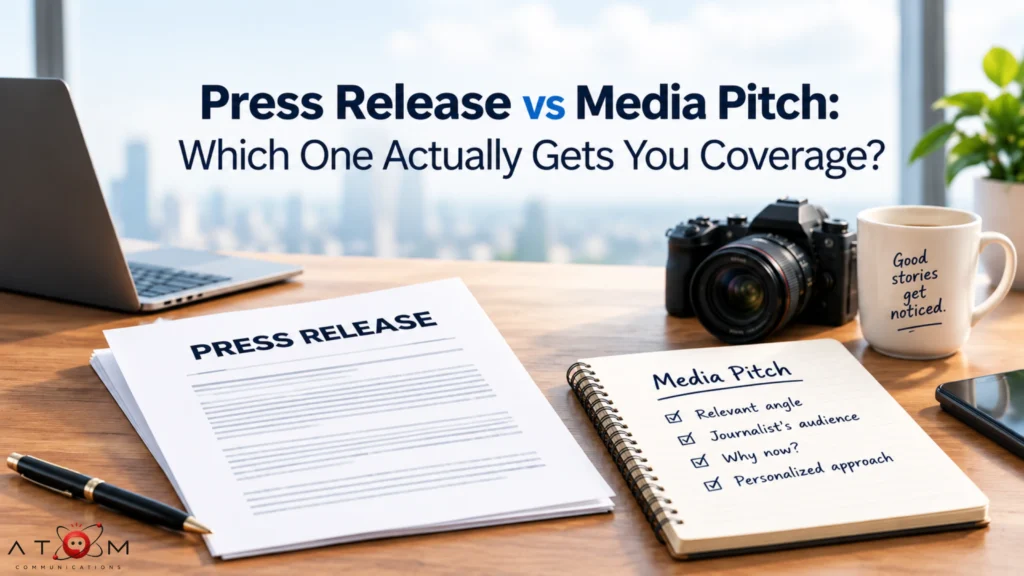
Press Release vs Media Pitch: Which One Actually Gets You Coverage?
SEO, AEO, and GEO get used interchangeably — but they optimize for three different buying moments. Here’s the real breakdown, and why early-stage B2B, fintech, and HR tech companies can’t treat GEO as optional in 2026.
What Google Ranking Actually Requires
Ensure Mobile-First Optimization
Local SEO Optimization
- Key takeaways
- Press releases and media pitches serve different purposes.
- Press releases communicate news at scale and create a public record of an announcement.
- Media pitches are personalized and designed to generate original editorial coverage.
- A strong pitch needs a compelling story angle, not just company news.
- Use both strategically: the release provides the facts, while the pitch creates the opportunity for deeper coverage.
- Original journalism can strengthen credibility and AI visibility more than repetitive syndicated content.
Founders often use “press release” and “media pitch” interchangeably, as if they’re two names for the same activity. They’re not. They’re different tools, built for different outcomes, and confusing them is one of the most common reasons PR efforts underperform.
Understanding the distinction — and when to use each — determines whether your next announcement gets genuine editorial coverage or just sits on a syndication page nobody reads.
What a Press Release Actually Is
A press release is a formal, one-way announcement. You write it, distribute it through wire services or directly to outlets, and it exists as a public record of news — a funding round, a leadership hire, a product launch. It doesn’t require a journalist’s participation to exist; it’s published whether or not anyone picks it up.
Its strength is scale and speed. A single release can go out to dozens of outlets simultaneously, create a searchable public record, and serve as a citable source for search engines and increasingly for AI models. Its weakness is that it rarely, on its own, produces original journalism. Most journalists treat an unsolicited release as raw material at best — something to reference, not something to build a story around.
Talk to an AI Marketing Expert to Scale Faster and Smarter
What a Media Pitch Actually Is
A pitch is a direct, personalized outreach to a specific journalist, proposing a story angle tailored to what that journalist actually covers. It’s not an announcement — it’s a conversation starter. A good pitch doesn’t say “here’s our news.” It says “here’s a story your readers would care about, and here’s why I thought of you specifically.”
Pitches require far more effort per outlet — research into what a journalist has recently written, an angle that isn’t just your company news but a broader trend or insight they can build a piece around, and a relationship maintained over time rather than a one-off email. The payoff is proportionally higher: a successful pitch produces original reporting, a journalist’s independent framing, and often deeper, more credible coverage than a release could ever generate alone.
Why This Distinction Matters for AI Visibility
This is where the choice stops being just a PR-craft question and becomes a GEO question too. Language models weight independent, original journalism more heavily than syndicated announcements, because original reporting reflects a journalist’s own verification and framing — a stronger trust signal than a company’s self-description repeated across wire networks.
A successful pitch that results in a bylined Economic Times or Moneycontrol article carries meaningfully more citation weight than the same news distributed as a press release across generic syndication sites. The release exists; the pitch-driven article gets trusted.
When Each One Is the Right Tool
Press releases make sense for time-bound, factual announcements that need a public record regardless of pickup — funding closes, regulatory filings, leadership transitions, product launches with a hard date. They’re also useful as a supporting asset alongside a pitch: send the release for the record, pitch the story for the coverage.
Pitches make sense when the goal is genuine editorial coverage — a founder profile, a trend piece your company exemplifies, an interview, a bylined opinion piece. These require an angle, not just news. “We raised money” is a release. “Why Series A fintech founders in India are avoiding growth-at-all-costs this year, and what that says about the market” is a pitch — even if your funding round is the hook.
Book a Free AI Marketing Strategy Consultation
The Founders Who Get This Wrong
The most common mistake is treating every announcement as pitch-worthy, sending the same generic message to fifty journalists with no personalization, and being surprised when nothing lands. The second most common mistake is the opposite — writing a release for something that genuinely deserved a pitched, original story, and settling for syndicated reach instead of real editorial coverage.
The Realistic Standard
A mature PR operation doesn’t choose one over the other — it uses both deliberately. Releases handle the record-keeping and baseline distribution. Pitches handle the actual credibility-building, the coverage that gets cited, shared, and — increasingly — trusted by the AI systems shaping how your category gets discovered.
At AtomComm, this is the operating principle behind every campaign: no release goes out without an assessment of whether the news deserves a pitch instead, and no pitch goes out without a clear, specific angle a journalist could actually use — because coverage that a journalist chose to write is worth more than coverage a system merely syndicated.
Get that sequencing right, and the next announcement does more than exist. It gets read, believed, and repeated.
Proof & Outcomes
Personalized pitches connect the right story with journalists who actually cover the topic.
A successful pitch can result in original reporting rather than simple syndicated publication.
Independent journalist coverage provides third-party validation that company-owned announcements cannot provide on their own.
FAQs
A press release is a formal announcement containing company news. A media pitch is a personalized message to a journalist proposing a specific story or angle.
Neither is universally better. Use a press release when you need to formally announce news and a media pitch when your goal is to generate original editorial coverage.
Press releases work well for significant announcements such as funding rounds, acquisitions, leadership changes, product launches and other time-sensitive company developments.
Use a media pitch when you have a compelling story angle, expert insight, founder perspective, trend, interview opportunity or industry development that fits a journalist's audience.
Book a Free PR Strategy Session
Tell us a bit about your brand and goals. We’ll share a tailored press plan and timeline.