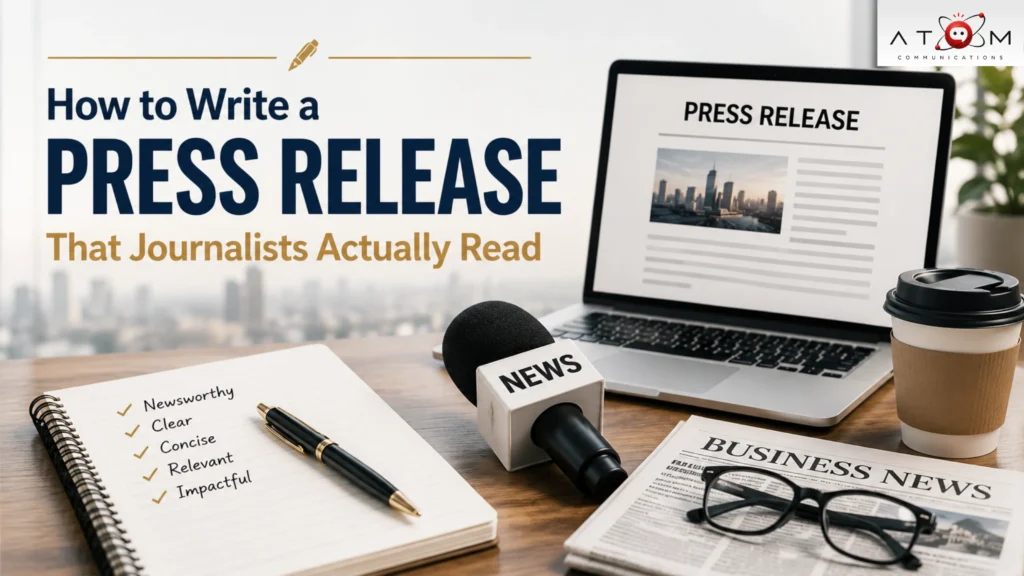
How to Write a Press Release That Journalists Actually Read
SEO, AEO, and GEO get used interchangeably — but they optimize for three different buying moments. Here’s the real breakdown, and why early-stage B2B, fintech, and HR tech companies can’t treat GEO as optional in 2026.
What Google Ranking Actually Requires
Ensure Mobile-First Optimization
Local SEO Optimization
- Key takeaways
- Lead with the news, not your company introduction.
- Use specific facts and numbers instead of promotional adjectives.
- Write founder quotes that offer a real opinion, insight or decision.
- Keep the structure easy to scan, with short paragraphs and front-loaded information.
- Ask why the story matters to the journalist’s audience before sending it.
- Write clearly enough for both journalists and AI systems to extract the important facts.
Most press releases die in the first line. A journalist scanning fifty emails before lunch gives your subject line and opening sentence about three seconds before deciding whether to keep reading or archive it. Understanding what happens in those three seconds is the difference between a release that gets covered and one that just gets distributed.
The Problem With Most Releases
Open any generic press release template and you’ll find the same pattern: a superlative-heavy headline (“Revolutionary,” “Game-Changing,” “Industry-Leading”), a boilerplate opening paragraph that buries the actual news under company description, and a quote from the founder that says nothing a reader couldn’t have guessed.
Journalists read hundreds of these. They’ve developed an instinct for filtering out promotional language almost automatically. The moment a release reads like an advertisement, it gets treated like one — skimmed, not covered.
Talk to an AI Marketing Expert to Scale Faster and Smarter
Lead With the News, Not the Company
The single most common mistake is opening with who you are instead of what happened. A journalist doesn’t need your company history in sentence one. They need to know, immediately, why this matters right now.
Compare two openings. “XYZ Fintech, a leading player in the digital lending space, is pleased to announce…” tells a journalist nothing they’ll act on. “XYZ Fintech has cut loan approval time from five days to four hours using a new underwriting model, following a Rs 40 crore Series A round” gives them a fact, a number, and a reason to keep reading — all in one sentence.
The formula that consistently works: lead with the specific, quantifiable news. Save company background for the second or third paragraph, where it belongs.
Specificity Beats Adjectives Every Time
“Innovative,” “cutting-edge,” “world-class” — these words do no work. They’re subjective claims a journalist can’t verify and won’t repeat. Numbers, mechanisms, and named details do the work instead.
Instead of “a powerful new AI platform,” write what the platform actually does: “an AI model that flags fraudulent claims within 90 seconds of submission.” Instead of “significant growth,” give the actual figure: “revenue grew from Rs 2 crore to Rs 11 crore over eighteen months.” Specificity isn’t just better writing — it’s what gets pulled into an article verbatim, because it’s something a journalist can fact-check and trust enough to cite.
Quotes Should Say Something, Not Just Exist
Most founder quotes in press releases are filler: “We’re thrilled to embark on this journey and are committed to excellence.” No journalist has ever used that line. A usable quote takes a position, offers a genuine insight, or explains a decision a reader might question.
A quote like “We deliberately chose not to raise a larger round because we wanted to prove unit economics before scaling spend” gives a journalist something with actual editorial value — a decision, a rationale, a bit of founder thinking that reads as real rather than rehearsed.
Book a Free AI Marketing Strategy Consultation
Structure for Skimming, Not Just Reading
Journalists scan before they read. A release with a clear headline, a strong first paragraph carrying the core news, short paragraphs after that, and a boilerplate at the end that a skimmer can safely skip is far more usable than a dense wall of text where the actual news is paragraph four.
This structure also matters for a second audience most founders aren’t thinking about yet: AI models. Releases written with clear, factual, front-loaded information extract more cleanly when a language model is pulling data to construct an answer about your company. A release that buries facts under adjectives gives a model less to work with — and less reason to treat your brand as a reliable source.
What Gets Ignored — And Why That's Useful Information
Anniversary announcements without news, generic “thought leader” quotes with no real position, and releases about internal reorganizations rarely land, because they don’t answer the journalist’s real question: why would my readers care about this today. Before writing a release, it’s worth asking that question honestly. If the answer isn’t clear, the release probably isn’t ready.
The Practical Standard
A release should be able to survive being read by a skeptical journalist who has no context on your company and thirty seconds to decide if it matters. If the first two sentences don’t pass that test, the rest of the document rarely gets read.
At AtomComm, this is the standard every release gets built to — written for the journalist’s actual decision-making process, not for a distribution checklist, because the entire point of a press release is that someone credible chooses to act on it.
Get the first two sentences right, and everything else — pickup, coverage, even AI citation down the line — becomes considerably easier to earn.
Proof & Outcomes
A clear headline and strong opening help journalists understand the story quickly.
News-led writing gives journalists a stronger reason to consider the announcement for coverage.
Useful founder commentary can provide an editorial angle rather than simply filling space.
FAQs
A good press release clearly communicates what happened, why it matters and why it matters now, using specific facts rather than promotional language.
There is no universal word count, but it should be concise enough for a journalist to quickly identify the news, supporting details and relevant quotes.
The opening should contain the most important news, ideally supported by a specific fact, number, announcement or development.
Usually, no. Lead with the news first. Company background and boilerplate information can come later.
Book a Free PR Strategy Session
Tell us a bit about your brand and goals. We’ll share a tailored press plan and timeline.