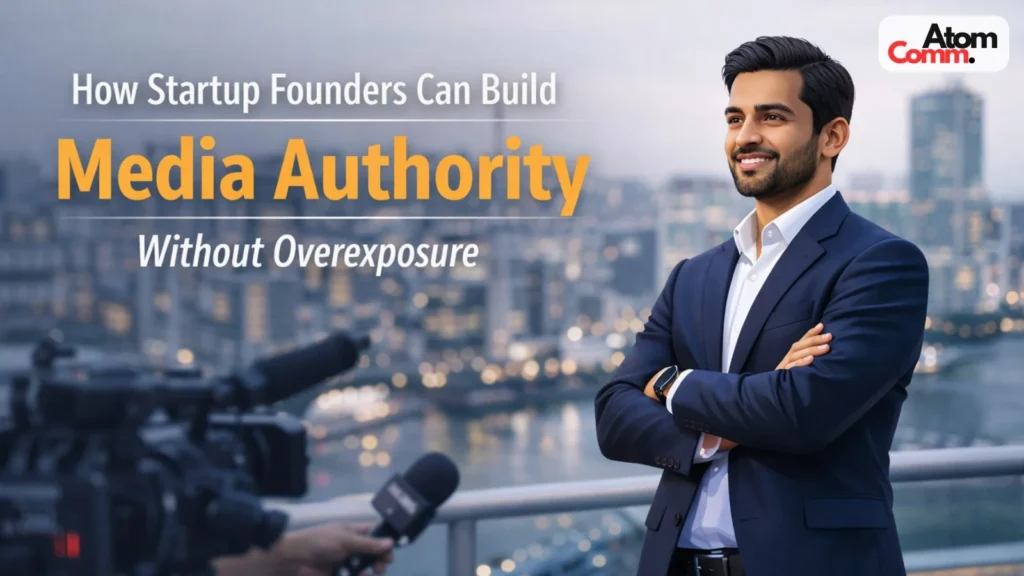
How Startup Founders Can Build Media Authority Without Overexposure
A strategic framework for Indian startup founders to build media authority through selective visibility, quality positioning, and sustainable engagement—avoiding the trap of overexposure that dilutes credibility.
What Media Authority Actually Means
Define Your One Core Narrative
Practice Strategic Selectivity
- Key takeaways
- Media authority is built through selective visibility, not constant presence
- Quality of coverage matters exponentially more than quantity in establishing credibility
- Overexposure dilutes positioning and creates audience fatigue
- Strategic silence is as powerful as strategic speaking when building authority
- Consistent messaging across limited touchpoints builds stronger recall than scattered opinions
- Founders who say “no” to most media build deeper trust in chosen appearances
- Long-form depth beats short-form frequency for lasting authority
- Media authority compounds when aligned with business milestones, not separated from them
- Personal brand strength increases when founders protect their narrative from dilution
The Overexposure Problem Indian Founders Face
Indian startup founders today face a paradox.
Media visibility has never been more accessible. LinkedIn, Twitter, podcasts, YouTube, press interviews, panel discussions, founder newsletters—the channels are endless. The barrier to being “seen” has collapsed.
But this accessibility has created a new problem: overexposure.
Founders who appear everywhere—commenting on every trend, accepting every podcast invite, posting daily hot takes—often struggle to build lasting authority. Their visibility is high, but their credibility becomes shallow.
Audiences begin to tune out. Journalists see them as “always available” rather than “selectively valuable.” Investors notice the contradiction between constant media presence and actual business execution.
The result? Visibility without authority. Noise without influence.
In 2026, the founders building the strongest media authority are not the loudest. They are the most strategically selective.
What Media Authority Actually Means
Media authority is not fame. It is not follower count. It is not being quoted in every tech publication.
Media authority is when:
- Journalists seek you out for expert commentary without prompting
- Your name becomes synonymous with a specific domain (e.g., fintech regulation, SaaS retention, climate tech funding)
- Your opinions influence industry conversations even when you’re not in the room
- Investors, customers, and talent trust your perspective based on your public positioning
- Your media appearances create lasting impact rather than temporary attention
Authority is earned through consistency, depth, and selectivity—not volume.
Why Overexposure Undermines Authority
Overexposure creates several credibility problems:
1. Diluted Positioning
When founders comment on everything—crypto one day, hiring trends the next, mental health the day after—they become generalists. Authority requires focus. The more topics you cover, the weaker your positioning becomes.
2. Audience Fatigue
Constant visibility leads to diminishing returns. Your 100th LinkedIn post gets less engagement than your 10th—not because quality dropped, but because attention exhausted.
3. Perceived Lack of Focus
If you’re always available for podcasts, panels, and interviews, audiences wonder: When are you building the company?
Investors especially notice this. Founders who prioritize media over execution signal misaligned priorities.
4. Lower Media Value
Journalists value exclusivity. If you’re quoted everywhere, your perspective loses premium. The founder who rarely speaks but delivers sharp insight when they do becomes more valuable to media.
5. Narrative Fragmentation
Every media appearance risks off-message moments. The more you speak, the higher the chance of contradictions, misquotes, or poorly framed statements that dilute your core narrative.
Talk to a Social Media Expert to Drive Engagement That Converts
The Strategic Authority Framework for Founders
Building authority without overexposure requires intentional discipline. Here’s how:
1. Define Your One Core Narrative
Authority requires singular focus. You cannot be known for everything.
Ask yourself:
- What one domain do I want to own in media conversations?
- What one problem does my company uniquely solve?
- What one perspective can I offer that others cannot?
Examples:
- Fintech founder: “Making credit accessible to underserved India”
- SaaS founder: “Helping Indian SMBs scale without enterprise bloat”
- Climate tech founder: “Decarbonizing supply chains in emerging markets”
Every media appearance should reinforce this singular narrative. If an opportunity doesn’t align, decline it.
2. Practice Strategic Selectivity
Not every media opportunity deserves a “yes.”
Say yes when:
- The platform aligns with your target audience (investors, customers, talent)
- The format allows depth (long-form interviews, case studies, industry panels)
- The timing supports business milestones (funding, product launch, expansion)
- The narrative opportunity is high-value (category-defining, contrarian insight, unique data)
Say no when:
- The topic is outside your core domain
- The format is shallow (quick soundbites, listicle quotes, generic panels)
- The audience doesn’t overlap with your stakeholders
- The effort-to-impact ratio is low
Founders who decline 80% of media requests build stronger authority than those who accept everything.
Talk to a Social Media Expert and Plan Your Growth the Right Way
3. Build Depth, Not Breadth
One deeply researched, data-backed thought leadership article in a tier-1 publication has more authority-building power than 50 LinkedIn posts.
High-authority formats:
- Long-form interviews (podcasts, written Q&As)
- Original research or data reports (industry surveys, market analysis)
- Op-eds in business publications (Financial Express, Business Standard, Economic Times)
- Case studies and post-mortems (what you learned from failure or success)
- Speaking at selective industry events (not every webinar, but key conferences)
Low-authority formats:
- Generic listicle quotes (“10 founders share their productivity tips”)
- Reactive hot takes on trending topics
- Daily motivational posts
- Panel discussions where you’re one of 8 speakers
- Rapid-fire Q&A formats that don’t allow nuance
Quality over quantity. Always.
4. Align Media with Business Milestones
Media visibility should amplify business momentum, not distract from it.
Strategic timing for media engagement:
- Pre-funding: Build credibility with investors through thought leadership
- Post-funding: Announce with strategic narrative, not just numbers
- Product launch: Position the “why now” and market gap clearly
- Market expansion: Establish expertise in the new geography or vertical
- Industry shifts: Provide informed commentary on regulatory changes, trends, or disruptions
Avoid media engagement when:
- You’re in deep execution mode (product development, team building)
- Business metrics are unclear or declining
- Key hires or partnerships are in sensitive negotiation stages
Media should serve the business, not the ego.
5. Control Your Narrative Through Owned Channels
The most authoritative founders maintain owned media channels where they set the narrative:
- Founder newsletter (monthly or quarterly deep dives)
- LinkedIn long-form articles (strategic, not daily)
- Company blog with founder byline (industry analysis, lessons learned)
- Annual shareholder or community letters (Buffett-style transparency)
Owned channels allow depth, control, and consistency. They build authority without requiring external validation.
But—crucially—these channels work only if maintained sparingly and intentionally. A monthly founder letter with deep insight beats a daily founder blog with shallow takes.
6. Master the Art of Strategic Silence
Silence is underrated.
Founders who comment on every trending topic, crisis, or industry debate dilute their authority. The founder who speaks rarely but powerfully becomes someone people wait to hear from.
Strategic silence signals:
- You’re building, not performing
- Your opinions are considered, not reactive
- You value quality over visibility
When you do speak, people listen.
7. Leverage PR, Don't Chase Media
Working with a PR agency or advisor helps founders focus on building the company while media relationships are managed strategically.
A good PR partner ensures:
- Media opportunities align with business goals
- Messaging stays consistent across platforms
- Founders are prepared for high-stakes interviews
- Media requests are filtered for quality and relevance
- Crisis communication is handled proactively
Founders who try to manage media themselves often overextend. Those who delegate to experts maintain better balance.
Real Examples: Founders Who Built Authority Through Selectivity
Example 1: The Silent Operator
An Indian SaaS founder rarely posts on social media, declines most podcast invites, and publishes one long-form article per quarter in Economic Times.
Result? When they speak, journalists, investors, and customers pay close attention. Their infrequent media presence creates anticipation, not fatigue.
Example 2: The Niche Expert
A fintech founder only discusses financial inclusion and regulatory challenges—never hiring, fundraising, or startup culture.
Result? They become the go-to expert for journalists covering fintech policy. Their narrow focus creates deep authority, not shallow visibility.
Example 3: The Data-Led Founder
A healthtech founder publishes original research reports twice a year and declines all other media.
Result? Their research gets cited by analysts, covered by media, and shared widely—building authority without constant personal visibility.
Talk to a Social Media Expert and Shape a Clear, Long-Term Content Strategy
Common Mistakes Founders Make with Media Visibility
Mistake 1: Confusing Visibility with Authority
Being seen often doesn’t mean being respected. Audiences remember depth, not frequency.
Mistake 2: Accepting Every Media Opportunity
FOMO drives founders to say yes to everything. Selectivity builds stronger positioning.
Mistake 3: Talking About Everything
Generalist positioning creates weak authority. Focus creates influence.
Mistake 4: Prioritizing Media Over Execution
Investors and customers care about results, not podcasts. Media should support business, not replace it.
Mistake 5: No Message Discipline
Saying different things in different forums fragments your narrative. Consistency builds authority.
How to Say "No" to Media Without Burning Bridges
Declining media opportunities is a skill. Here’s how to do it gracefully:
Template 1: Wrong Topic
“Thanks for thinking of me. This topic falls outside my core expertise in [your domain]. I’d recommend reaching out to [suggest alternative founder]. Happy to connect you.”
Template 2: Wrong Timing
“I appreciate the invite, but we’re heads-down on [product launch/fundraise/expansion] right now. I’d love to revisit this in [specific timeframe] if the opportunity is still relevant.”
Template 3: Wrong Format
“I typically focus on long-form conversations where I can add deeper insight. If you’re open to a different format [article/podcast/case study], I’d be happy to explore that.”
Saying no with grace maintains relationships while protecting your positioning.
Media Authority in 2026: What's Changed
Compared to previous years, building founder authority in 2026 requires:
| 2022–2024 Approach | 2026 Approach |
|---|---|
| Post daily on LinkedIn | Post strategically and sparingly |
| Accept every podcast invite | Decline 80% of requests |
| Comment on every trend | Focus only on core domain expertise |
| Chase media coverage | Let media come to you |
| Generalist positioning | Niche authority positioning |
| Quantity-driven visibility | Quality-driven credibility |
The shift reflects audience maturity. Indian stakeholders—investors, customers, journalists—now value signal over noise.
The Long Game: Authority Compounds, Visibility Fades
Visibility is temporary. Authority is permanent.
A viral LinkedIn post gets attention for 48 hours. A well-positioned thought leadership article in Economic Times gets referenced for years.
Founders who chase visibility optimize for short-term dopamine hits—likes, comments, shares.
Founders who build authority optimize for long-term compounding—trust, credibility, influence.
In 2026, the question isn’t:
“How do I get more visible?”
It’s:
“How do I become someone worth listening to?”
And the answer is: strategic selectivity, narrative discipline, and depth over breadth.
Talk to a Social Media Expert and Shape a Clear, Long-Term Content Strategy
Proof & Outcomes
Founders with selective media presence are perceived as execution-focused, not attention-seeking.
Consistent messaging across limited touchpoints creates clearer positioning than scattered visibility.
Top candidates respect founders who prioritize building over performing.
FAQs
There's no fixed rule, but aim for quality over frequency. One high-impact interview per quarter is more valuable than weekly podcast appearances. Let business milestones guide timing.
Yes, but strategically. Post when you have something meaningful to say—original data, contrarian insight, lessons learned. Avoid daily hot takes or motivational content.
Politely explain it's not the right fit, suggest alternatives, and leave the door open for future collaboration. Journalists respect founders who are selective.
Absolutely. Many authoritative founders maintain minimal social presence but publish occasional long-form thought leadership or speak at selective industry events.
Book a Free PR Strategy Session
Tell us a bit about your brand and goals. We’ll share a tailored press plan and timeline.