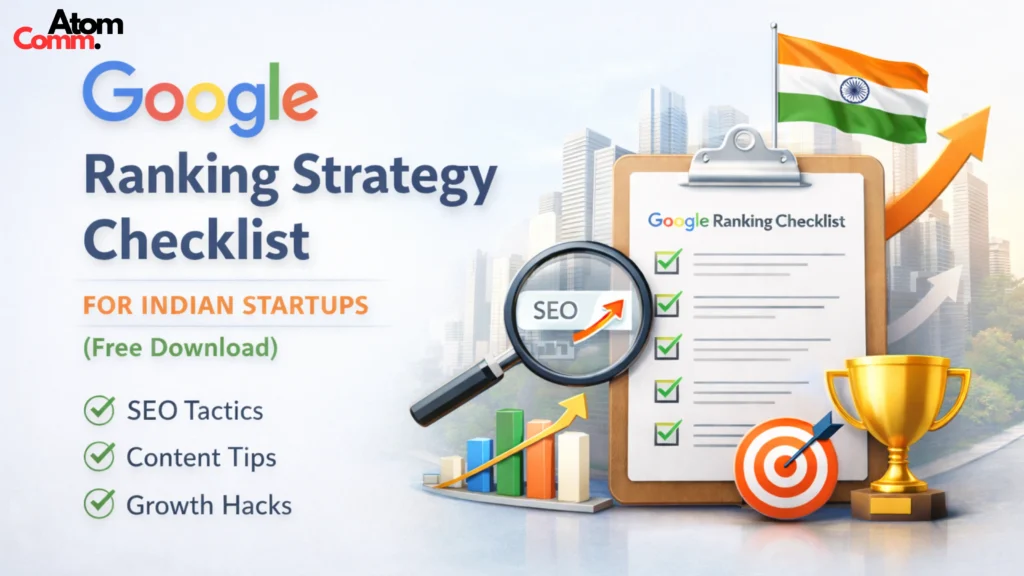
Google Ranking Strategy Checklist for Indian Startups (Free Download)
A practical Google ranking strategy checklist for Indian startups to build search visibility faster in 2026 by focusing on foundations, intent, authority, and trust—not shortcuts.
Rankings Are a System, Not a Tactic
Authority Is the Real Differentiator
Google Ranking Strategy Checklist
- Key takeaways
- Google rankings in 2026 function as a credibility signal, not just an SEO metric
- Indian startups rank faster when SEO is treated as a system, not a set of tactics
- Strong foundations (site health, structure, indexing) accelerate all future SEO work
- Search intent clarity matters more than keyword volume
- Authority and external validation increasingly influence ranking stability
- Internal linking plays a critical role in distributing ranking power
- Trust signals quietly determine whether rankings hold or decay over time
- A structured checklist helps teams avoid months of low-impact execution
For Indian startups today, ranking on Google is no longer just an SEO milestone. It has become a credibility signal.
When a potential customer, investor, journalist, or candidate searches for your company or category, your visibility on Google quietly shapes perception. Strong rankings imply relevance and trust. Weak or inconsistent visibility raises questions—regardless of how strong the product or traction may be.
This is where most startups struggle. Not because they ignore SEO, but because they approach it without structure. Tactics are tried before strategy is defined. Content is published before authority is built. Keywords are targeted without clarity on intent.
A Google ranking strategy checklist brings discipline into this process. Not as a list of hacks, but as a framework that helps startups focus on what actually drives sustainable rankings in 2026.
Why Google Rankings Have Become More Difficult for Indian Startups
India’s digital ecosystem is now deeply competitive across every category—SaaS, fintech, healthtech, D2C, services, marketplaces. AI has made content production easier, but it has also increased noise. From Google’s perspective, distinguishing real expertise from manufactured content has become harder.
In response, ranking systems have matured. New domains face higher scrutiny. Thin or generic content struggles to hold position. Authority and consistency matter much earlier in a company’s lifecycle.
This is why many startups spend months “doing SEO” without meaningful movement. The effort exists, but the sequencing is wrong. Foundations are skipped in favour of visible activity.
Rankings Are a System, Not a Tactic
Google rankings do not depend on a single lever.
They emerge when site structure, search intent, content depth, user experience, trust signals, and external validation reinforce one another. When even one of these elements is weak, progress slows—even if everything else looks active.
A checklist works because it forces alignment. It prevents teams from scaling content or link-building while unresolved structural or credibility gaps quietly block momentum.
Talk to an SEO Expert to Build Long-Term Search Visibility
Foundations Decide How Fast Everything Else Works
Many Indian startups begin SEO with publishing. This often delays results.
If a website loads slowly on mobile, has unclear architecture, indexing issues, or duplicate pages, Google struggles to interpret it. Even high-quality content underperforms in these conditions.
Ranking faster usually starts by removing friction rather than increasing output. Once technical and structural foundations are clean, every page compounds more effectively.
Search Intent Is Where Most Rankings Are Won or Lost
In 2026, keywords without intent are incomplete.
Google prioritises pages that clearly satisfy why a user is searching. Informational, comparative, and transactional searches behave differently—and mixing them often weakens relevance.
Startups that rank faster tend to design pages with a single, clear purpose. They don’t attempt to answer every possible question. They solve one problem thoroughly and let internal linking handle expansion.
This clarity is increasingly important in competitive Indian search results.
Authority Is the Real Differentiator
Content quality is now expected. Authority is what separates durable rankings from temporary ones.
Google evaluates who is behind the content and whether the brand is recognised beyond its own website. Mentions, citations, leadership visibility, and credible references all contribute to this assessment.
This is where SEO overlaps with brand narrative and public visibility. At AtomComm, this connection between search visibility and reputation-building is often where startups begin to see acceleration—once authority is treated as an asset, not an afterthought.
Talk to an SEO Expert to Drive Sustainable Organic Growth
Internal Structure Shapes Ranking Distribution
Internal linking remains one of the least understood ranking accelerators.
When structured intentionally, it signals topical depth, guides authority to priority pages, and improves navigation. It helps Google understand what matters most on the site.
Startups that design internal links as part of strategy—not cleanup—often see ranking improvements without publishing new content.
Trust Signals Stabilise Rankings Over Time
Trust erosion rarely looks dramatic. It happens quietly.
Anonymous content, unclear business details, exaggerated claims, inconsistent messaging, or outdated pages slowly weaken credibility. Google notices these inconsistencies even when users don’t articulate them consciously.
Startups that signal transparency and accountability tend to retain visibility through algorithm changes. Trust becomes a stabiliser, not just a ranking factor.
Measuring Progress Beyond Position Tracking
Rankings fluctuate naturally. Visibility patterns matter more.
Early SEO momentum often appears as increased branded searches, broader keyword coverage, better engagement from organic users, and higher-quality inbound interest. These indicators usually precede sustained ranking gains.
Startups that focus only on rank reports often miss this progression.
Why a Google Ranking Strategy Checklist Speeds Up Results
A checklist does not promise shortcuts.
It reduces wasted effort.
By forcing teams to address foundations, intent, authority, trust, and structure in the right order, it shortens the learning curve and prevents months of low-impact execution.
Ranking faster is rarely about working harder. It’s about sequencing correctly.
Google Ranking Strategy Checklist for Indian Startups
To support this approach, a free Google Ranking Strategy Checklist has been created for Indian startups operating in competitive search environments.
It helps teams evaluate readiness, identify hidden gaps, prioritise high-impact actions, and align SEO with long-term business objectives. At AtomComm, this checklist is often used as a working reference—revisited as the brand, product, and market evolve.
The checklist is meant to guide thinking, not replace it.
Talk to an SEO Expert to Drive Sustainable Organic Growth
Proof & Outcomes
Faster initial ranking movement due to cleaner SEO foundations
Improved visibility across high-intent and branded search terms
Better alignment between SEO efforts and business credibility
FAQs
Yes. It is designed specifically to help early and growth-stage startups prioritise correctly without over-investing too early.
No checklist can guarantee rankings, but this framework significantly reduces wasted effort and improves ranking efficiency.
Ideally every 3–6 months, or after major product, positioning, or content changes.
No. It complements audits by helping teams interpret and prioritise what actually matters.
Book a Free PR Strategy Session
Tell us a bit about your brand and goals. We’ll share a tailored press plan and timeline.