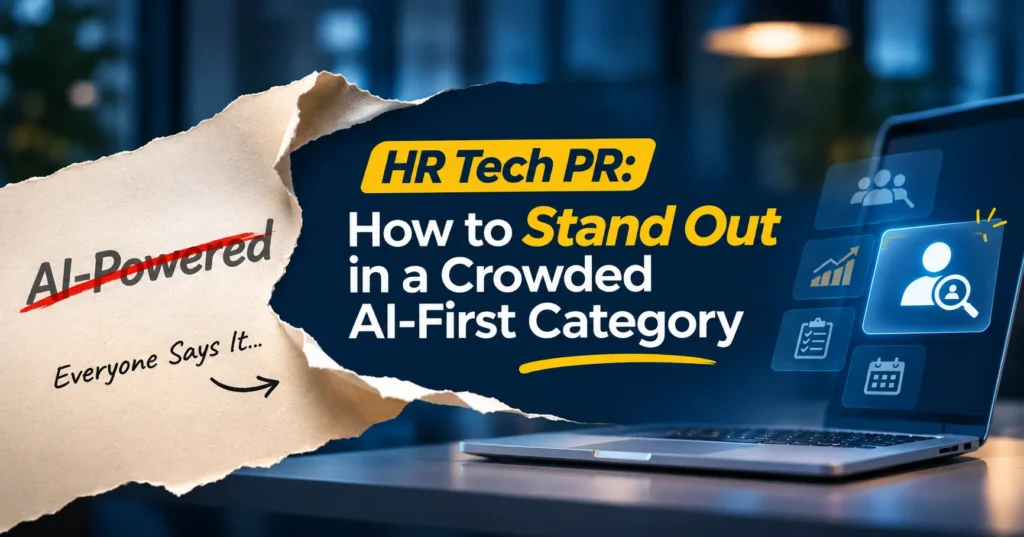
HR Tech PR: How to Stand Out in a Crowded AI-First Category
SEO, AEO, and GEO get used interchangeably — but they optimize for three different buying moments. Here’s the real breakdown, and why early-stage B2B, fintech, and HR tech companies can’t treat GEO as optional in 2026.
What Google Ranking Actually Requires
Ensure Mobile-First Optimization
Local SEO Optimization
- Key takeaways
Evaluate media placement quality: Distinguish original editorial coverage from syndicated press releases.
Check domain authority: Assess publication credibility, relevance, and potential SEO value rather than counting mentions alone.
Ask about AI visibility: Understand how the agency approaches brand discovery and citations in AI-generated answers.
Review actual reports: Look for share of voice, media quality, SEO indicators, and measurable campaign outcomes.
Confirm who handles your account: Identify the team responsible for pitching, writing, and communication.
Compare pricing with deliverables: Clarify the number of pitches, target publications, distribution costs, and reporting included.
Set realistic expectations: Choose an agency that adapts its strategy when pitches do not generate coverage.
Every HR tech company pitching a journalist in 2026 claims to use AI. Recruitment platforms, engagement tools, payroll systems, performance management software — nearly all of them now describe themselves as “AI-powered” somewhere in the first line of the pitch. That word has stopped functioning as differentiation. It’s become table stakes, which means most HR tech PR pitches sound identical, and most get ignored for exactly that reason.
Why "AI-Powered" Stopped Working as a Pitch Angle
A journalist covering HR tech at People Matters or ET Edge Insights reads dozens of pitches a month claiming AI-driven recruitment, AI-powered engagement scoring, AI-based performance insights. The word has become noise rather than signal. Leading a pitch with “AI-powered” today tells a journalist nothing about what actually makes your company worth covering — it just confirms you’re using the same technology as your competitors.
The founders getting real coverage in this category have stopped leading with the technology and started leading with the specific problem it solves, backed by a real number or outcome. Not “AI-powered recruitment platform,” but “cut time-to-hire from 45 days to 12 for mid-sized manufacturing firms.” The AI is implied by the outcome; it doesn’t need to be the headline anymore.
Talk to an AI Marketing Expert to Scale Faster and Smarter
Finding an Angle Beyond the Product
In a crowded category, the story that gets covered is rarely “here’s our product.” It’s usually one of a few reliable angles: a genuine trend the company’s data reveals (attrition patterns across a sector, hiring shifts in a specific city tier), a founder’s contrarian take on a widely accepted HR tech assumption, or a specific customer outcome detailed enough to be credible rather than a vague success story.
Indian HR tech has particularly rich trend material right now — the shift toward tier-2 and tier-3 city hiring, the gig economy’s growing overlap with formal HR systems, the skills gap in AI-adjacent roles. A company that can speak credibly to these broader shifts, using its own data as evidence, earns coverage that a generic product pitch never will, because it gives the journalist a story bigger than a single company.
Why This Category Rewards Founder Visibility Specifically
HR tech sits at an interesting intersection — it’s a technology category, but the buyers are HR leaders who care as much about philosophy and approach to workplace issues as they do about feature sets. This makes founder-led thought leadership unusually effective here compared to more purely technical categories. A founder with a genuinely considered point of view on AI’s role in hiring fairness, or on the risks of over-automating people decisions, tends to earn more credible coverage than another product announcement, because HR trade press specifically values perspective from people building in this space.
Publications like People Matters and HR Katha actively seek this kind of commentary, which makes founder bylines a more accessible entry point into consistent coverage than waiting for product news to justify a pitch.
Standing Out in AI-Generated Category Comparisons
This is where the crowded-AI-category problem becomes most acute. When a prospective buyer asks ChatGPT or Perplexity to recommend HR tech platforms for a specific use case — AI recruitment tools for enterprise, or engagement platforms for distributed teams — the models are drawing from whichever companies have the most credible, specific, corroborated coverage. A company whose entire public footprint says “AI-powered” without differentiation gives these models nothing distinctive to cite. A company whose coverage includes specific outcomes, sector focus, and independent validation gives the model something concrete to work with when constructing a recommendation.
This means the crowded-category problem in traditional search — everyone using the same keywords — is repeating itself in AI visibility, and the fix is the same: specificity and genuine differentiation beat repetition of the category buzzword every time.
Book a Free AI Marketing Strategy Consultation
A Practical Framework for HR Tech Founders
Retire “AI-powered” as a headline claim and replace it with the specific outcome it produces. Identify one or two genuine sector trends your product data can speak to credibly, and pitch those as standalone stories rather than always tying coverage to a product announcement. Invest in founder-led commentary on real tensions in the category — automation versus human judgment in hiring, data privacy in workforce analytics — rather than only speaking when there’s news to announce. And check periodically how your brand shows up when AI models are asked to compare HR tech options in your specific niche, since that comparison is happening whether or not you’re part of it.
At AtomComm, HR tech engagements are built around finding the angle beyond the AI claim, because in a category where every competitor says the same thing, the story that gets covered and eventually cited — is the one with something specific enough to actually be true only of you.
Proof & Outcomes
Editorial coverage: The number and quality of relevant original media placements, reported separately from syndicated mentions.
SEO performance: Changes in relevant backlinks, referring domains, and other agreed-upon organic visibility indicators.
AI visibility: Baseline and follow-up assessments of the brand's presence in relevant AI-generated answers.
FAQs
Evaluate the agency's startup experience, editorial media relationships, placement quality, reporting standards, AI visibility strategy, account team, and clarity of deliverables. Request real campaign reports and relevant case studies before signing.
Costs vary depending on campaign scope, agency experience, target publications, outreach volume, and strategic support. Request an itemized proposal covering pitching, press release writing, distribution, reporting, and additional fees.
A monthly report should cover media placements, publication relevance, share of voice, campaign progress, and agreed SEO or visibility indicators. AI visibility tracking can also be included where appropriate.
Editorial coverage is independently selected and produced by a publication's journalists or editors. Syndicated placements distribute the same press release or content through multiple outlets. Both should be clearly distinguished in campaign reports.
Book a Free PR Strategy Session
Tell us a bit about your brand and goals. We’ll share a tailored press plan and timeline.