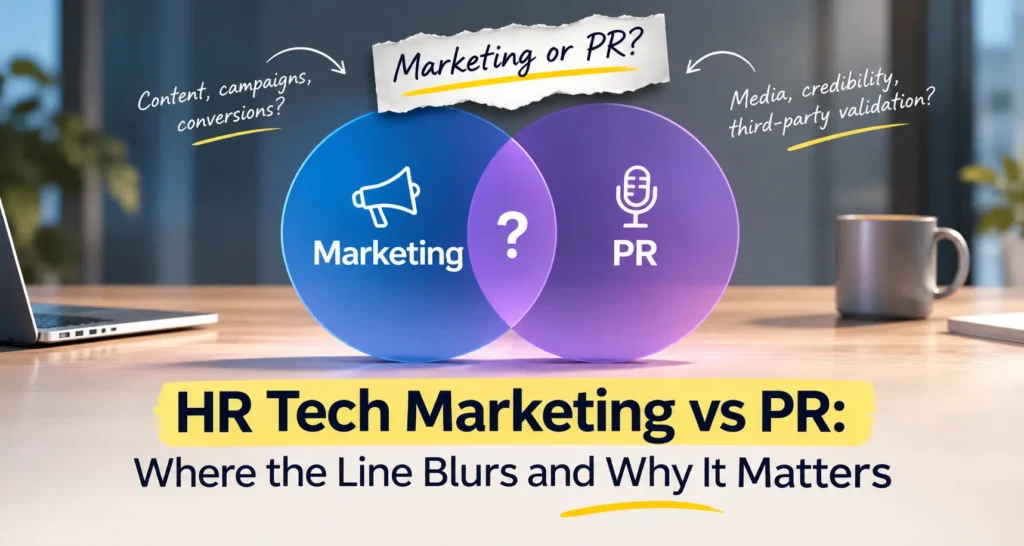
HR Tech Marketing vs PR: Where the Line Blurs and Why It Matters
SEO, AEO, and GEO get used interchangeably — but they optimize for three different buying moments. Here’s the real breakdown, and why early-stage B2B, fintech, and HR tech companies can’t treat GEO as optional in 2026.
What Google Ranking Actually Requires
Ensure Mobile-First Optimization
Local SEO Optimization
- Key takeaways
Evaluate media placement quality: Distinguish original editorial coverage from syndicated press releases.
Check domain authority: Assess publication credibility, relevance, and potential SEO value rather than counting mentions alone.
Ask about AI visibility: Understand how the agency approaches brand discovery and citations in AI-generated answers.
Review actual reports: Look for share of voice, media quality, SEO indicators, and measurable campaign outcomes.
Confirm who handles your account: Identify the team responsible for pitching, writing, and communication.
Compare pricing with deliverables: Clarify the number of pitches, target publications, distribution costs, and reporting included.
Set realistic expectations: Choose an agency that adapts its strategy when pitches do not generate coverage.
Ask an HR tech founder to explain the difference between their marketing team’s work and their PR effort, and the answer is often vague — something about “marketing does content, PR does press.” That distinction was clean enough a decade ago. It’s considerably blurrier now, and founders who don’t understand where the line actually sits tend to either duplicate effort across both functions or leave real gaps that neither team owns.
Why the Old Distinction Doesn't Hold Up
Traditionally, marketing owned owned channels website content, email, paid campaigns, social while PR owned earned channels: press coverage, journalist relationships, media placements. The founder’s job was to fund both and let each stay in its lane.
That division assumed a clean separation between “things we publish ourselves” and “things a third party validates.” AI-driven discovery has quietly dissolved that separation. A blog post on your own site and a bylined article in ET Edge Insights are now both potential inputs into how a language model understands and cites your company but they carry very different weight, because one is self-published and the other is independently validated. Marketing and PR teams that don’t coordinate around this distinction end up working at cross purposes without realizing it.
Talk to an AI Marketing Expert to Scale Faster and Smarter
Where Marketing Still Clearly Owns the Work
Owned content — product pages, feature announcements, in-app messaging, paid acquisition campaigns, email nurture sequences — remains squarely a marketing function. This content serves prospects already in your funnel, and its job is conversion, not credibility-building with an external audience. No amount of PR sophistication replaces a marketing team’s need to write clear product content and run efficient acquisition campaigns
Where PR Still Clearly Owns the Work
Earned coverage, journalist relationships, press releases tied to genuine news, and founder media appearances remain PR’s domain. These require skills — pitching, relationship management, understanding what makes a story newsworthy to an external editor — that most marketing teams aren’t built for and shouldn’t try to absorb, because a marketing team pitching journalists without PR discipline usually produces exactly the kind of generic, self-promotional outreach that gets ignored.
Where the Line Genuinely Blurs
The overlap shows up in a few recurring places. Thought leadership content is the clearest example — a founder’s LinkedIn post on hiring trends and a bylined article in People Matters are structurally similar content, but one is owned and self-published, the other is earned and independently vetted. Both matter, but they do different work: the LinkedIn post builds a founder’s personal audience, the bylined article builds third-party credibility that shows up in a journalist’s or a language model’s trust calculus.
SEO content is another blurred zone. A company blog optimized for search keywords is a marketing asset, but if that same content is thin on substance and heavy on keyword repetition, it does nothing for the credibility layer PR is trying to build — and can actively undercut it if a prospect or a model encounters inconsistent claims across owned versus earned content.
Company narrative and messaging is the most consequential overlap. If marketing’s website copy claims one positioning and PR’s media pitches emphasize a different angle, both journalists and AI models encounter contradictory signals about who the company actually is. This inconsistency is often invisible internally — each team feels their materials are accurate — but externally, it reads as a company that doesn’t have a clear, coherent identity.
Book a Free AI Marketing Strategy Consultation
Why This Matters More Now
AI models don’t distinguish between “official marketing copy” and “earned media coverage” the way a human reader intuitively does — they synthesize from whatever sources exist, weighting credible, independent sources more heavily, but still absorbing inconsistencies across a company’s total public footprint. A company whose owned and earned content tell subtly different stories is giving a model conflicting information to reconcile, which tends to produce vaguer, less confident answers about the brand — exactly the opposite of what strong AI visibility requires
A Practical Fix: Shared Narrative, Separate Execution
The functional split between marketing and PR execution should stay — different skill sets, different relationships, different cadences. What needs to be shared is the underlying narrative: the specific claims, numbers, and positioning language both teams use, reviewed together rather than developed in separate silos. A quarterly sync between marketing and PR — not to merge the teams, but to reconcile messaging — catches inconsistencies before they end up baked into a year’s worth of content and coverage.
For HR tech specifically, where the “AI-powered” claim is nearly universal across competitors, this coordination matters even more: if marketing’s website leads with generic AI language while PR is pitching a more specific, differentiated angle to journalists, the company ends up with two competing versions of its own story circulating publicly at the same time.
The Standard Worth Building To
Marketing and PR don’t need to become one function. They need to stop operating as if the content each produces exists in separate universes, when increasingly, both owned and earned content are being read, weighed, and synthesized by the same audience — human and AI alike — trying to understand who you actually are.
At AtomComm, this is a deliberate part of how PR engagements are scoped — not replacing a client’s marketing function, but ensuring the narrative PR builds in earned media is the same one showing up across owned channels, because a fractured story is a weaker story no matter which team is telling it.
Proof & Outcomes
Editorial coverage: The number and quality of relevant original media placements, reported separately from syndicated mentions.
SEO performance: Changes in relevant backlinks, referring domains, and other agreed-upon organic visibility indicators.
AI visibility: Baseline and follow-up assessments of the brand's presence in relevant AI-generated answers.
FAQs
Evaluate the agency's startup experience, editorial media relationships, placement quality, reporting standards, AI visibility strategy, account team, and clarity of deliverables. Request real campaign reports and relevant case studies before signing.
Costs vary depending on campaign scope, agency experience, target publications, outreach volume, and strategic support. Request an itemized proposal covering pitching, press release writing, distribution, reporting, and additional fees.
A monthly report should cover media placements, publication relevance, share of voice, campaign progress, and agreed SEO or visibility indicators. AI visibility tracking can also be included where appropriate.
Editorial coverage is independently selected and produced by a publication's journalists or editors. Syndicated placements distribute the same press release or content through multiple outlets. Both should be clearly distinguished in campaign reports.
Book a Free PR Strategy Session
Tell us a bit about your brand and goals. We’ll share a tailored press plan and timeline.