
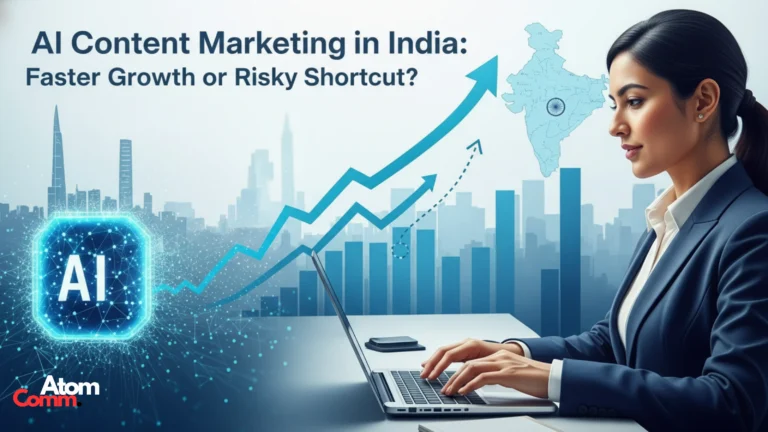
AI Content Marketing in India: Faster Growth or Risky Shortcut?
AI content marketing is reshaping how Indian brands scale visibility. This guide explores where AI accelerates growth — and where over-automation risks credibility, trust, and long-term performance.
Authenticity Over Perfection
AI Video Marketing Actually Means
Where AI Video Works Best for Indian Brands
For years, video marketing in India followed a familiar formula: expensive shoots, long production timelines, location logistics, talent coordination, and heavy post-production costs. While effective, this model was slow, inflexible, and often out of sync with how fast digital platforms now move.
By 2026, that model is rapidly changing.
AI video marketing is no longer an experimental tool used by tech companies alone. It is becoming a practical, scalable alternative to traditional video shoots for Indian brands across sectors — from D2C and SaaS to fintech, education, and real estate.
The shift is not about replacing creativity.
It’s about replacing inefficiency.
Why AI Content Took Off So Quickly in India
Indian businesses operate under intense pressure: rising ad costs, short attention spans, and constant demand for fresh content. AI solved a very real pain.
It offered:
- Faster content production
- Lower dependence on large teams
- Easier scaling across platforms
- Support for regional language output
For startups, SMEs, and even large brands, AI content felt like a practical solution to an overwhelming demand for visibility.
And in the short term, it worked.
Where AI Content Marketing Actually Delivers Value
AI is genuinely useful when applied to execution-heavy tasks.
In India, AI content performs best when used for:
- First drafts and outlines
- Content repurposing across platforms
- Headline and angle testing
- Summarising long reports or interviews
- Structuring SEO content efficiently
It reduces friction.
It speeds up workflows.
It frees teams to focus on thinking rather than typing.
In these roles, AI is not a replacement — it’s an efficiency layer.
The Risk: When Speed Replaces Substance
The problem begins when AI content becomes the strategy, not the support.
Indian audiences are now exposed to thousands of AI-written pieces every day. Patterns are easy to spot:
- Generic phrasing
- Recycled advice
- Surface-level insights
- Over-optimised SEO language
- Lack of original perspective
This kind of content may rank temporarily or generate engagement, but it rarely builds trust.
In high-consideration categories — SaaS, fintech, healthcare, consulting, education, B2B services — credibility matters more than volume. AI content without human expertise often sounds confident but hollow.
And hollow content erodes authority faster than silence.
Google, Trust, and the E-E-A-T Problem
Search engines have become far better at identifying low-value content.
Google’s focus on Experience, Expertise, Authoritativeness, and Trustworthiness (E-E-A-T) puts AI-only content at a disadvantage — especially when it lacks:
- First-hand experience
- Original analysis
- Credible authorship
- External validation
Indian websites relying heavily on generic AI blogs often see:
- Initial ranking spikes
- Followed by stagnation or decline
- Poor engagement metrics
- Weak conversion rates
AI can help optimise content.
It cannot manufacture trust.
AI Content vs Indian Consumer Behaviour
Indian buyers research deeply. They cross-check brands, read reviews, search founders, and compare narratives before making decisions.
Content that converts in India typically:
- Explains complexity clearly
- Reflects real experience
- Acknowledges trade-offs
- Sounds human, not promotional
AI struggles with nuance, context, and cultural sensitivity — especially across regions and languages.
Without strong editorial control, AI content risks:
- Misrepresenting claims
- Oversimplifying regulated topics
- Losing cultural relevance
- Damaging brand credibility
Growth built on weak trust doesn’t scale.
Where AI Becomes a Risky Shortcut
AI content turns risky when brands:
- Replace writers instead of augmenting them
- Publish without human review
- Chase volume instead of clarity
- Optimise only for keywords, not intent
- Ignore originality and differentiation
This approach may reduce cost in the short term, but it increases:
- Brand dilution
- SEO penalties
- Audience fatigue
- Long-term recovery cost
The real cost of bad content is not poor performance — it’s lost trust.
The Smarter Model: Human-Led, AI-Assisted Content
The most successful Indian brands in 2026 follow a clear principle:
AI accelerates execution. Humans own insight.
In this model:
- Strategy is defined by humans
- Positioning is intentional
- Expertise comes from experience
- AI supports structure, speed, and scale
This creates content that is:
- Faster to produce
- Stronger in substance
- Consistent in voice
- Credible across channels
AI becomes a competitive advantage — not a liability.
AI Content Works Best When Integrated, Not Isolated
AI content delivers real growth when integrated with:
- PR and earned media
- SEO strategy beyond keywords
- Founder and leadership narratives
- Social distribution with context
- Clear conversion pathways
Isolated AI content creates noise.
Integrated AI content builds momentum.
Final Verdict: Accelerator or Shortcut?
AI content marketing is not inherently risky.
Unthinking AI usage is.
For Indian brands, AI is a powerful accelerator when:
- Used with editorial discipline
- Guided by real expertise
- Anchored in trust and clarity
It becomes a risky shortcut when:
- Speed replaces thinking
- Volume replaces value
- Automation replaces accountability
The brands that win in the next phase of India’s digital growth will not be the ones producing the most content.
They will be the ones producing the most believable content — faster, smarter, and with intent.
AI doesn’t decide that.
Humans still do.
Here’s the SEO-ready wrap-up for
“AI Content Marketing in India: Faster Growth or Risky Shortcut?” — clean, credible, and CXO-friendly.
Proof & Outcomes
Lower operational costs across blogs, social, and SEO
Stronger alignment with Google’s E-E-A-T standards
Reduced risk of content fatigue and brand dilution
FAQs
Yes, when used with human oversight, clear strategy, and editorial review.
It can, but long-term rankings depend on expertise, originality, and trust — not automation alone.
Only when overused or published without human refinement. Generic content erodes trust.
First drafts, outlines, summaries, repurposed content, and SEO structure support.
Book a Free PR Strategy Session
Tell us a bit about your brand and goals. We’ll share a tailored press plan and timeline.