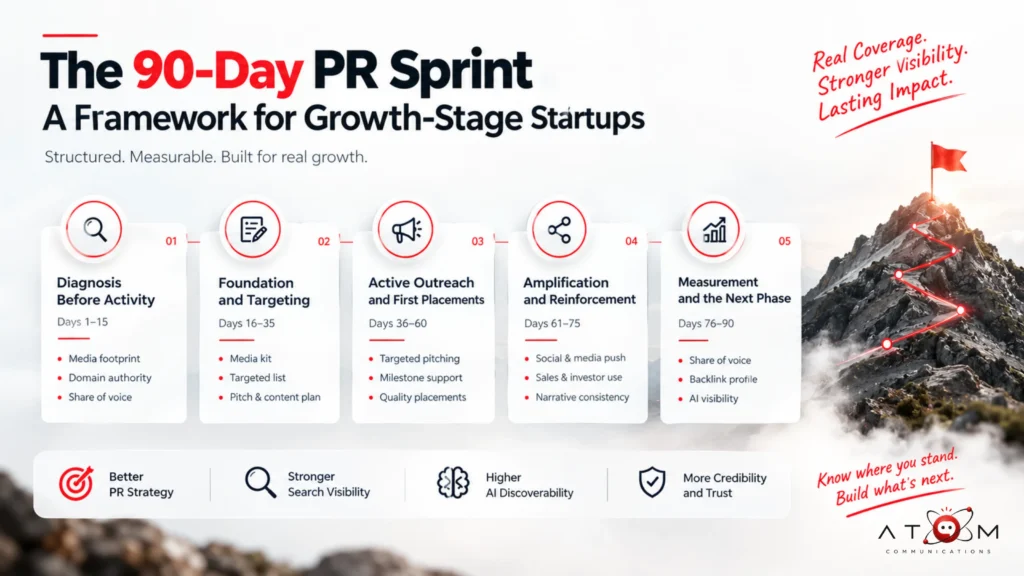
The 90-Day PR Sprint: A Framework for Growth-Stage Startups
SEO, AEO, and GEO get used interchangeably — but they optimize for three different buying moments. Here’s the real breakdown, and why early-stage B2B, fintech, and HR tech companies can’t treat GEO as optional in 2026.
What Google Ranking Actually Requires
Ensure Mobile-First Optimization
Local SEO Optimization
- Key takeaways
A signal audit provides a structured view of a brand’s presence across media, search, and AI-generated answers.
Media coverage quality, editorial credibility, and backlink relevance matter beyond the total number of press placements.
Domain authority and backlink analysis help identify opportunities to strengthen organic search visibility.
Share of voice analysis shows how a brand’s media presence compares with relevant competitors.
AI citation checks across ChatGPT, Perplexity, and Gemini help identify gaps in AI discoverability.
Wikipedia and Wikidata status and narrative consistency can reveal gaps in a brand’s structured knowledge and public positioning.
A useful audit should produce an evidence-based, prioritized action plan rather than simply recommend more PR activity.
Most PR engagements start the same way: a founder signs a retainer, waits, and three months later asks what actually happened. The problem usually isn’t effort — it’s the absence of a structured plan with visible milestones along the way. A 90-day sprint fixes that by breaking PR into phases with clear outputs at each stage, rather than a vague ongoing activity that’s hard to evaluate until well after the money’s spent.
Here’s what a disciplined version of that sprint actually looks like.
Days 1–15: Diagnosis Before Activity
The instinct at the start of any engagement is to start pitching immediately. That’s a mistake. The first two weeks should be diagnostic: a signal audit establishing where the brand actually stands — existing media footprint, domain authority profile, share of voice against named competitors, and current presence in AI-generated answers across ChatGPT, Perplexity, and Gemini.
This phase also covers narrative groundwork: confirming the company’s positioning is factually consistent, building or updating the media kit, and identifying two or three realistic story angles rather than a generic “we’re innovative” pitch that no journalist will act on. Skipping this phase is the single most common reason 90-day sprints underdeliver — activity without a clear baseline produces coverage that doesn’t compound into anything measurable.
Talk to an AI Marketing Expert to Scale Faster and Smarter
Days 16–35: Foundation and Targeting
With the audit complete, this phase builds the infrastructure the rest of the sprint depends on. That means finalizing the media kit, mapping a realistic target list of journalists and outlets by beat rather than by aspirational reach, and drafting the first wave of pitches and releases with the specificity that actually gets covered — real numbers, real mechanisms, no adjective-heavy filler.
This is also when founder-led content gets planned: which bylined pieces make sense for which outlets, what expertise the founder can credibly speak to, and a realistic cadence rather than an ambitious one that collapses under actual bandwidth. For Indian B2B companies, this is the point to prioritize sector-specific outlets — ET Edge Insights, People Matters, CXO Today — alongside Tier-1 national press, since sector credibility often opens doors that generic pitches don’t. A structured PR playbook for Indian startups can also provide a useful reference for planning outreach and campaign execution.
Days 36–60: Active Outreach and First Placements
This is the execution core of the sprint — direct pitching to the targeted list, coordinated with any milestone announcements (funding, product launches, partnerships) that give journalists a genuine news hook. The goal here isn’t volume of pitches sent; it’s a realistic number of quality placements that reflect actual editorial credibility, not syndicated reach.
Each placement secured in this window should be evaluated against the same standard from the domain authority discussion: is this outlet one that passes real editorial weight to both search engines and AI systems, or is it filling a report without moving anything that matters. A sprint focused on five strong placements in outlets like Financial Express or Moneycontrol will outperform one chasing twenty low-tier mentions, every time.
Days 61–75: Amplification and Reinforcement
Coverage secured in the previous phase needs reinforcement to compound. This includes founder and company social amplification of placements, internal use of coverage in sales and investor materials, and follow-up pitches building on initial stories — a funding announcement covered in week six can often support a founder interview or trend piece by week ten, if the follow-up is planned rather than left to chance.
This phase is also where narrative consistency gets checked across everything published so far — making sure the story being told in press coverage matches what’s on the website, the media kit, and any founder commentary elsewhere, since inconsistency at this stage undermines the credibility the sprint has been building.
Book a Free AI Marketing Strategy Consultation
Days 76–90: Measurement and the Next Phase
The sprint closes with a genuine report, not a vanity summary. That means reviewing share of voice movement against named competitors, checking whether domain authority and backlink profile have shifted, and re-running the AI citation check from the initial audit to see whether the brand’s presence in AI-generated category answers has changed at all. The PR metrics and performance guide outlines measures that can help evaluate media quality, share of voice, SEO impact, and thought leadership.
This comparison — day one baseline against day ninety outcome — is what separates a real PR sprint from ninety days of undifferentiated activity. It also sets up an honest conversation about what the next phase should prioritize: doubling down on what worked, correcting what didn’t, or shifting focus toward a specific gap the data revealed, like weak AI visibility despite strong traditional coverage. For a broader perspective on connecting earned media with organic search performance, see Why PR + SEO Is Essential for Indian Brands.
Why 90 Days Is the Right Window
Shorter sprints don’t allow enough time for pitches to convert into placements, or for a first wave of coverage to compound into follow-up stories. Longer commitments without a measurement checkpoint let underperforming strategies run too long before anyone notices. Ninety days is long enough to produce real, evaluable results and short enough to force discipline at every phase.
At AtomComm, this structure — audit, foundation, outreach, amplification, measurement — is the framework every growth-stage engagement runs on, because a founder deserves to know, with real data, whether the last three months moved anything that matters before committing to the next three.
Proof & Outcomes
Media coverage: Number, relevance, quality, and originality of earned placements.
Media targeting: Outreach to relevant journalists and publications, alongside response and conversion rates.
Search visibility: Changes in organic traffic, relevant keyword performance, and referring-domain quality.
FAQs
A 90-day PR sprint is a structured public relations programme divided into five phases: diagnosis, foundation and targeting, active outreach, amplification, and measurement. Each phase has defined activities and deliverables.
It gives startups a clear timeframe for planning, executing, and evaluating PR activity. Regular checkpoints help founders assess progress and make informed decisions before committing to the next phase.
The first 15 days should focus on a baseline audit, competitor visibility, media coverage, brand positioning, media kit preparation, and identifying realistic story angles.
There is no universal target. The appropriate number depends on the startup's industry, story strength, available resources, and target publications. Relevant, credible editorial coverage is generally more valuable than pursuing placement volume alone.
Book a Free PR Strategy Session
Tell us a bit about your brand and goals. We’ll share a tailored press plan and timeline.