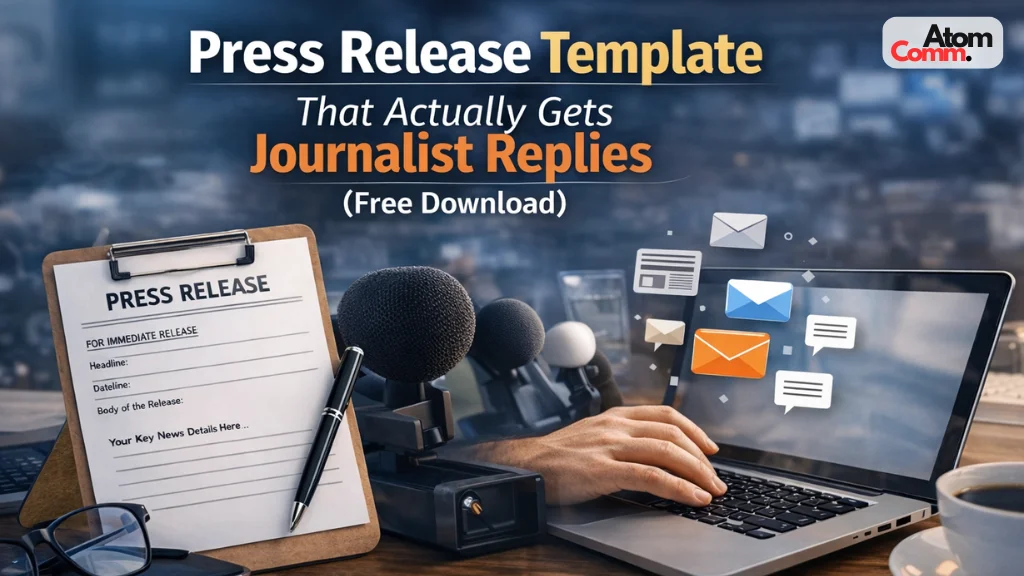
Press Release Template That Actually Gets Journalist Replies (Free Download)
A practical guide to writing press releases that journalists actually open, read, and respond to—plus a free, newsroom-ready press release template designed for today’s Indian media landscape.
Journalists Decide Whether to Respond
The Role of Timing and Restraint
Why Automation Hurts More Than It Helps
- Key takeaways
-
Press releases fail when they are written for brands, not for journalists
-
Journalists scan for relevance, not excitement or ambition
-
Clarity and context matter more than creative language or hype
-
A strong press release explains what changed and why it matters now
-
Founder quotes should offer insight, not celebration
-
Proof points reduce editorial risk and increase reply rates
-
Over-communicating weakens credibility with the media
-
Press releases shape long-term reputation, even without coverage
-
Templates work only when used as thinking frameworks, not shortcuts
-
Trust with journalists is built over time, one disciplined release at a time
Most press releases don’t fail because of poor writing.
They fail because they’re written without a clear understanding of how journalists evaluate information.
In 2026, journalists are operating under intense pressure. Newsrooms are leaner, inboxes are flooded, and attention spans are shorter. A press release is no longer “read” — it is scanned, judged, and filtered in seconds.
For a release to earn a reply, it must immediately answer one question:
Is this worth a journalist’s time and their audience’s attention?
This is where most brands go wrong.
Why Press Releases Break Trust Instead of Building It
Many press releases try too hard to sound impressive. They lead with ambition instead of relevance, vision instead of outcomes. Over time, this erodes trust with journalists.
From the newsroom’s point of view, overly promotional releases create friction. They force journalists to dig for the actual story, verify exaggerated claims, or reject the pitch altogether.
At Atom Comm, we’ve seen this repeatedly while auditing press materials for startups and growing brands. The problem is rarely effort — it’s framing. The release speaks from the company’s perspective, not the reader’s.
A release that builds trust doesn’t attempt to “sell” the brand. It explains change — clearly and calmly.
How Journalists Decide Whether to Respond
Journalists don’t respond because a brand is popular or well-funded. They respond because the story aligns with:
- Their beat,
- The publication’s audience, and the current news cycle.
A strong press release respects this reality. It does not assume importance — it demonstrates relevance.
This is why releases that get replies often feel understated. They are precise, factual, and grounded in context. They allow journalists to form their own judgment instead of being pushed toward a conclusion.
Talk to a PR Expert to Shape Your Brand Narrative and Media Strategy
Structuring a Press Release for Editorial Reality
The structure of a press release matters because it mirrors how journalists read.
The subject line is not a headline — it is a decision trigger. It must communicate the outcome of the story, not the excitement around it.
Once opened, the headline reinforces that clarity. It should explain what changed rather than what launched. Journalists are far more interested in impact than intention.
The opening paragraph functions as a filter. If the story is not immediately clear here, the release rarely gets read further. This paragraph should stand on its own, even if nothing else is read.
From there, context becomes the differentiator. Explaining why this development matters within the industry is far more effective than listing features or future plans. Context shows awareness — and awareness signals credibility.
Founder quotes should sound like perspective, not celebration. Journalists reuse quotes that add interpretation or insight into the market, not those that repeat the announcement.
Proof points then anchor the story. Real numbers, validated outcomes, or credible partners reduce doubt and make the story easier to stand behind editorially.
Why Most Templates Fail — and How to Use One Properly
Most press release templates fail because they are treated as shortcuts. Teams fill in sections without thinking about whether the story itself is strong.
A template works only when it forces better thinking:
- Is this actually news?
- Who does this matter to?
- Why now?
- What can we prove, not just claim?
At Atom Comm, templates are used as filters, not fillers. If a story can’t pass through the structure clearly, it usually isn’t ready for media yet.
This approach protects both the brand and the journalist relationship over time.
The Role of Timing and Restraint
One of the most overlooked aspects of press releases is restraint. Not every internal milestone needs external visibility. Over-communicating early can weaken credibility later.
A well-designed press release framework helps teams decide when not to pitch. It creates discipline around timing and prevents dilution of narrative value.
This is especially important for startups, where early attention can attract scrutiny before the business is ready to sustain it.
Free Download: Press Release Template Designed for Indian Media
To support teams building this discipline, we’ve created a free press release template designed specifically for the Indian media environment in 2026.
It’s structured to help teams think through relevance, context, and proof before distribution — not to automate outreach.
The template reflects how journalists actually read, not how brands wish to be seen.

How Atom Comm Uses This Framework in Practice
At Atom Comm, press releases are treated as strategic assets, not routine documents. Each release is evaluated for narrative alignment, timing, and editorial fit before it ever reaches a journalist’s inbox.
This is how brands build long-term media trust — not through volume, but through consistency and clarity.
A press release that gets replies is rarely louder than others.
It is simply clearer.
Why Journalist Replies Depend on Trust Built Over Time
One press release rarely determines whether a journalist replies. What actually drives responses is pattern recognition.
Journalists remember which brands consistently send clear, relevant information — and which ones waste their time. Over months, this pattern builds either trust or resistance.
When a journalist sees an email from a brand they trust, they open it differently. They expect clarity. They expect accuracy. They expect restraint. That expectation alone increases reply rates more than any formatting trick.
At Atom Comm, we often see brands underestimate this long-term effect. They focus on perfecting one release, while overlooking the cumulative impact of their communication history. A press release that gets replies is often the result of prior discipline, not just current effort.
Talk to a PR Expert to Turn Visibility into Credibility
The Cost of Over-Explaining and Over-Positioning
Another reason press releases fail is over-explanation.
Founders and marketing teams often try to tell the entire company story in one release. The result is dense, unfocused communication that forces journalists to work harder than they should.
A strong release does the opposite. It isolates one clear development and explains it well. Everything else is left for future stories.
Over-positioning — excessive branding language, aggressive market claims, inflated projections — creates friction. Journalists instinctively push back against content that feels like it’s trying to control their interpretation.
Editorial-friendly releases leave room for interpretation. They provide facts, context, and perspective — not conclusions.
The Relationship Between Press Releases and Media Pitches
A press release alone rarely secures coverage. It works best when paired with a thoughtful pitch.
The pitch explains why this release matters to this journalist. The release provides the factual backbone.
When the release is clear and well-structured, the pitch can be shorter and more respectful. Journalists are far more likely to reply when they don’t feel trapped in a long explanation.
This is another reason templates matter. A strong release reduces dependency on follow-ups, clarifications, and persuasion.
Why Automation Hurts More Than It Helps
With AI tools becoming more accessible, many teams now generate press releases faster than ever. Speed, however, often comes at the cost of judgment.
Automated releases tend to:
- Overuse generic language
- Miss cultural or regulatory nuance
- Ignore editorial context
- Flatten brand voice
Journalists can spot automation instantly. And once they do, reply rates drop sharply.
AI can assist drafting, but editorial decisions must remain human-led. Press releases are not data outputs — they are reputation documents.
This is why Atom Comm treats technology as a support layer, not a substitute for strategic thinking.
The Template as a Thinking Tool, Not a Document
The press release template we’ve shared is not meant to standardize communication. It’s meant to slow teams down just enough to ask the right questions before publishing.
Does this matter externally?
Can we explain it in one paragraph?
What proof do we have today?
What’s better saved for later?
When teams use templates this way, press releases stop being routine tasks and start becoming deliberate reputation assets.
Talk to a PR Expert to Align PR with Business Growth Goals
Proof & Outcomes
Write clearer, more relevant press releases that respect newsroom realities
Reduce ignored pitches caused by over-promotion or weak framing
Build long-term trust with media through consistent, credible communication
FAQs
Founders, startup marketing teams, PR professionals, and growth leaders who want better media response without relying on hype.
No template can guarantee coverage. It improves clarity, relevance, and credibility—key factors that increase journalist replies.
Yes. The structure and guidance reflect how Indian journalists and digital newsrooms operate in 2026.
Yes. It works well for funding rounds, product launches, partnerships, and milestone updates when used with proper judgment.
Book a Free PR Strategy Session
Tell us a bit about your brand and goals. We’ll share a tailored press plan and timeline.