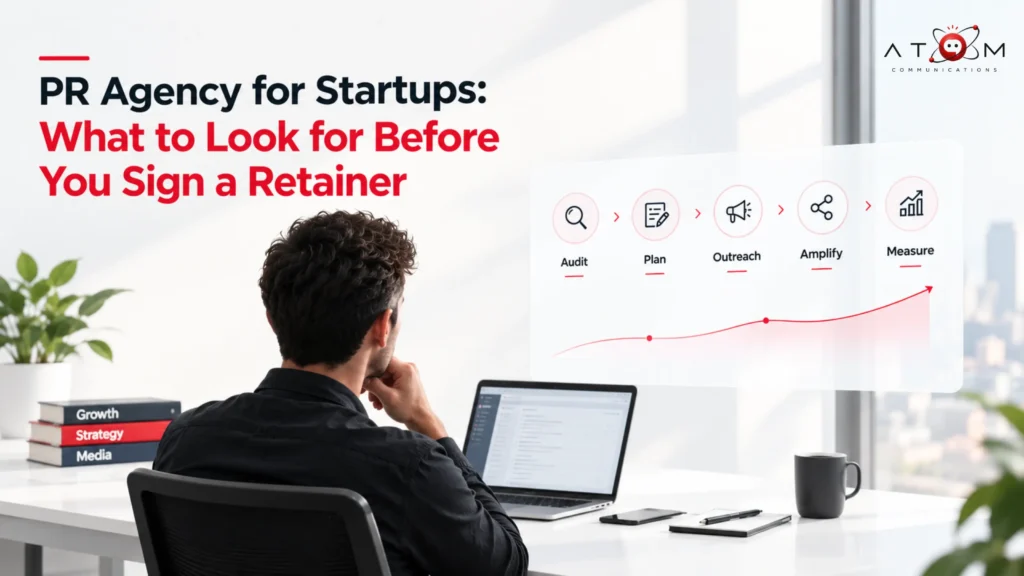
PR Agency for Startups: What to Look for Before You Sign a Retainer
SEO, AEO, and GEO get used interchangeably — but they optimize for three different buying moments. Here’s the real breakdown, and why early-stage B2B, fintech, and HR tech companies can’t treat GEO as optional in 2026.
What Google Ranking Actually Requires
Ensure Mobile-First Optimization
Local SEO Optimization
- Key takeaways
Evaluate media placement quality: Distinguish original editorial coverage from syndicated press releases.
Check domain authority: Assess publication credibility, relevance, and potential SEO value rather than counting mentions alone.
Ask about AI visibility: Understand how the agency approaches brand discovery and citations in AI-generated answers.
Review actual reports: Look for share of voice, media quality, SEO indicators, and measurable campaign outcomes.
Confirm who handles your account: Identify the team responsible for pitching, writing, and communication.
Compare pricing with deliverables: Clarify the number of pitches, target publications, distribution costs, and reporting included.
Set realistic expectations: Choose an agency that adapts its strategy when pitches do not generate coverage.
Most founders sign their first PR retainer based on a pitch deck full of logos — publications the agency has “placed clients in,” a promise of coverage volume, and a monthly fee that sounds reasonable against the size of the ask. Three months later, many discover the logos were mostly syndicated placements, the coverage didn’t move any metric that mattered, and the agency’s real capability didn’t match the pitch.
Here’s what’s actually worth evaluating before signing, based on where these engagements typically go wrong.
Ask How They Define a "Placement"
This is the single highest-leverage question in the entire evaluation. Some agencies count a syndicated press release appearing on two hundred low-authority aggregator sites as two hundred placements. Others count only genuine editorial pickup — a journalist choosing to write an original story. These are not remotely comparable outcomes, and an agency that doesn’t clearly distinguish between the two in its reporting is likely optimizing for a number that looks good on a slide, not one that moves your actual visibility.
Ask directly: of your typical placements, what percentage come from original journalism versus wire syndication? A confident, specific answer is a good sign. Vagueness is not.
Talk to an AI Marketing Expert to Scale Faster and Smarter
Check Whether They Understand Domain Authority
A competent agency should be able to explain, without prompting, why a placement in Financial Express carries more SEO and credibility value than the same story on a generic aggregator. If domain authority isn’t part of how they select targets or report results, they’re operating on an outdated model that treats all coverage as equal — which it isn’t, and hasn’t been for a while.
Ask About Their AI Visibility Approach — And Notice If They Have One
This is the newest and most revealing filter. Ask directly: how does your PR strategy account for how AI models like ChatGPT and Perplexity discover and cite brands? Most agencies, even established ones, don’t yet have a real answer, because GEO is still an emerging discipline most PR shops haven’t built into their process.
An agency that can speak fluently about the difference between building for traditional search versus building for AI citation — and can point to how their placement strategy accounts for both — is meaningfully ahead of one still running a 2018 SEO-and-syndication playbook. For a Series A/B founder thinking about visibility over the next three to five years, this gap matters more than it might seem in month one.
Request Real Reporting Before You Sign
Ask to see a sample client report — not a case study slide, an actual monthly or quarterly report. Look for whether it includes share of voice against named competitors, domain authority tracking, and any measurement beyond impressions. If the sample report is mostly a logo wall and a total reach number, that’s very likely what your reports will look like too.
Book a Free AI Marketing Strategy Consultation
Understand the Actual Team, Not Just the Pitch
Agency pitches are frequently delivered by senior account leads who then hand execution to junior staff once the retainer is signed. Ask specifically who will be doing the actual pitching and writing on your account, what their experience level is, and whether the person in the pitch meeting will be involved day-to-day. This is a common and reasonable point of negotiation — and an agency uncomfortable being specific about it is worth a second look.
Clarify Pricing Against Deliverables, Not Just a Monthly Number
Startup PR retainers in India vary widely, and the number alone tells you little without knowing what’s actually included — number of pitches per month, target outlet tiers, whether press release writing and distribution costs are separate, whether reporting and strategy calls are built in or billed additionally. A lower retainer with vague deliverables is often more expensive in practice than a higher one with clear, trackable outputs.
Ask What Happens If Coverage Doesn't Land
PR outcomes are never fully guaranteed, and any agency promising guaranteed placements in specific Tier-1 outlets should be treated with real skepticism — that’s not how earned media works. What’s reasonable to ask instead is how the agency adjusts strategy when initial pitches don’t land, and whether their reporting is honest about misses as well as wins.
The Realistic Standard
The right agency for a growth-stage company isn’t necessarily the one with the biggest client logos — it’s the one that can clearly explain how it defines success, measures it honestly, and has already adapted its approach to include AI visibility rather than treating it as a future consideration.
At AtomComm, every prospective client conversation starts with these exact questions answered upfront — placement definitions, domain authority approach, AI visibility strategy, and real reporting samples — because a founder evaluating a retainer deserves that clarity before signing, not three months into discovering it was missing.
Proof & Outcomes
Editorial coverage: The number and quality of relevant original media placements, reported separately from syndicated mentions.
SEO performance: Changes in relevant backlinks, referring domains, and other agreed-upon organic visibility indicators.
AI visibility: Baseline and follow-up assessments of the brand's presence in relevant AI-generated answers.
FAQs
Evaluate the agency's startup experience, editorial media relationships, placement quality, reporting standards, AI visibility strategy, account team, and clarity of deliverables. Request real campaign reports and relevant case studies before signing.
Costs vary depending on campaign scope, agency experience, target publications, outreach volume, and strategic support. Request an itemized proposal covering pitching, press release writing, distribution, reporting, and additional fees.
A monthly report should cover media placements, publication relevance, share of voice, campaign progress, and agreed SEO or visibility indicators. AI visibility tracking can also be included where appropriate.
Editorial coverage is independently selected and produced by a publication's journalists or editors. Syndicated placements distribute the same press release or content through multiple outlets. Both should be clearly distinguished in campaign reports.
Book a Free PR Strategy Session
Tell us a bit about your brand and goals. We’ll share a tailored press plan and timeline.