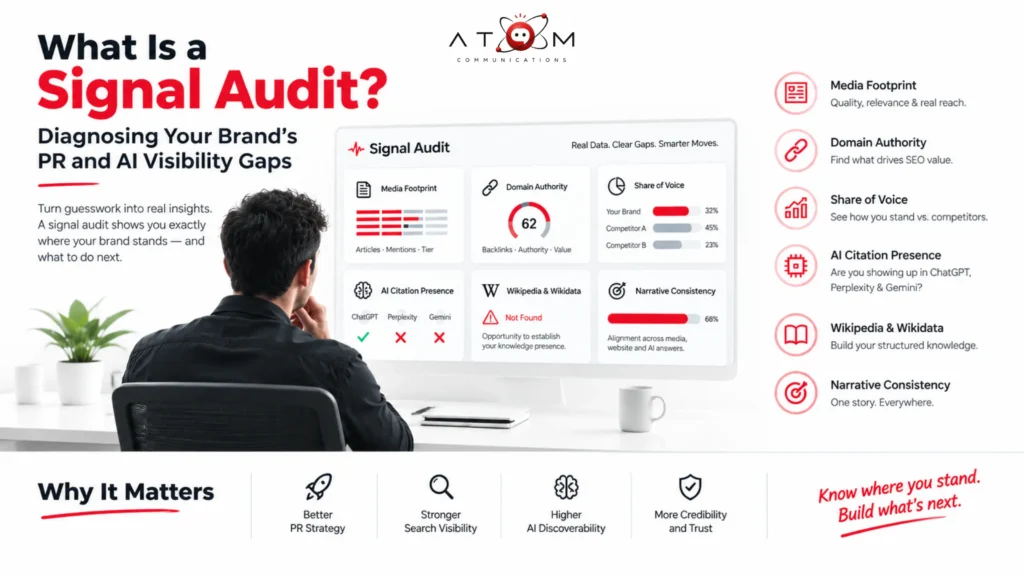
What Is a Signal Audit? Diagnosing Your Brand's PR and AI Visibility Gaps
SEO, AEO, and GEO get used interchangeably — but they optimize for three different buying moments. Here’s the real breakdown, and why early-stage B2B, fintech, and HR tech companies can’t treat GEO as optional in 2026.
What Google Ranking Actually Requires
Ensure Mobile-First Optimization
Local SEO Optimization
- Key takeaways
A signal audit provides a structured view of a brand’s presence across media, search, and AI-generated answers.
Media coverage quality, editorial credibility, and backlink relevance matter beyond the total number of press placements.
Domain authority and backlink analysis help identify opportunities to strengthen organic search visibility.
Share of voice analysis shows how a brand’s media presence compares with relevant competitors.
AI citation checks across ChatGPT, Perplexity, and Gemini help identify gaps in AI discoverability.
Wikipedia and Wikidata status and narrative consistency can reveal gaps in a brand’s structured knowledge and public positioning.
A useful audit should produce an evidence-based, prioritized action plan rather than simply recommend more PR activity.
Most founders can tell you their last funding round, their current ARR, and their churn rate down to the decimal. Ask the same founder how their brand actually shows up across media coverage, search results, and AI-generated answers, and the answer is usually a shrug. That gap — precise numbers everywhere except the one area shaping how prospects discover and trust you — is what a signal audit is built to close.
Why "Visibility" Has Been Hard to Diagnose
PR has historically resisted the kind of rigorous diagnostic that other functions take for granted. You can’t easily open a dashboard and see your brand’s actual media footprint, its domain authority profile, its share of voice against named competitors, and its presence inside AI-generated answers, all in one place. Most companies either don’t measure this at all, or measure fragments of it — a Google Alert here, an SEO tool there — without ever assembling a full picture.
A signal audit is that full picture, built deliberately rather than pieced together from scattered tools.
Talk to an AI Marketing Expert to Scale Faster and Smarter
What a Signal Audit Actually Examines
Existing media footprint. A structured inventory of every meaningful mention your brand has across credible outlets — not just count, but tier, recency, and whether coverage is original reporting or syndicated repetition. This establishes the actual baseline most founders are guessing at.
Domain authority and backlink profile. Which placements are contributing real SEO value, and which are inflating a report without moving anything that matters. This often reveals that a company with an impressive-sounding placement count has a surprisingly thin authority footprint, because most of that coverage came from low-tier syndication. Understanding Google’s spam policies for web search can also help businesses recognize the risks associated with manipulative link-building practices.
Share of voice against named competitors. Not aspirational category leaders, but the two or three companies you actually compete against for the same buyer’s attention. This shows whether your coverage volume is translating into relative standing, or whether a competitor is quietly dominating the conversation while you’re generating activity without traction. Learn more about PR metrics and performance measurement.
AI citation presence. A direct check across ChatGPT, Perplexity, and Gemini — asking both direct questions about your brand and open category questions where you’d expect to be named. This is the part of the audit most founders have never run themselves, and it frequently produces the most surprising results: brands with solid traditional PR completely absent from AI-generated category answers, because that credibility layer was never built deliberately. A dedicated AI Citation Audit for ChatGPT and Gemini can help investigate these visibility gaps.
Wikipedia and Wikidata status. Whether your brand exists in the structured knowledge layer that underpins a significant share of how language models understand entities, and if not, how far away that is realistically, given current coverage. Review Wikipedia and Wikidata to understand these public knowledge resources.
Narrative consistency. Whether the story your company tells about itself matches what’s actually been published about you. Founders often assume their positioning is consistent because it’s consistent in their own messaging — the audit checks whether it’s consistent in the outside world’s record, which is what actually shapes both journalist and AI trust.
Why This Needs to Be a Diagnostic, Not a Pitch
A useful audit doesn’t start with recommendations. It starts with an honest accounting of where things actually stand, even when that’s less flattering than a founder expects. The value of a signal audit comes specifically from its objectivity — it’s not built to justify a retainer, it’s built to show, with evidence, where the real gaps are, so that whatever comes next is based on data rather than assumption.
This matters because founders consistently misjudge their own visibility in both directions. Some assume they have no coverage worth building on, when in fact they have a solid foundation that’s simply never been leveraged for AI visibility. Others assume their media presence is strong, when a domain authority and AI citation check reveals it’s mostly noise sitting on low-authority syndication pages.
Why This Matters More at Series A/B Stage
Early-stage companies rarely have years of accumulated coverage to fall back on, which means every visibility gap is more consequential and more fixable at the same time. A signal audit at this stage isn’t diagnosing decades of drift — it’s catching a young brand’s visibility footprint while it’s still small enough to correct deliberately, before bad habits like over-reliance on generic distribution get baked into the strategy.
Book a Free AI Marketing Strategy Consultation
What Comes After the Audit
The output isn’t just a scorecard — it’s a prioritized plan: which coverage gaps matter most, which outlets are worth pursuing first for both credibility and AI trust, what needs fixing structurally (a stale media kit, an absent Wikidata entry, a narrative inconsistency across old coverage), and a realistic sequence for closing the gap rather than an overwhelming list attempted all at once.
At AtomComm, the Signal Audit is deliberately the first deliverable in any engagement, because building a PR and AI visibility strategy without first measuring the actual starting point is how most companies end up spending budget on activity that never compounds into anything.
Know where you actually stand before deciding where to go next. Everything after that is easier to get right.
Proof & Outcomes
Media footprint: Document brand mentions, publication quality, coverage recency, and original reporting.
Domain authority and backlinks: Assess referring domains, backlink quality, and potential SEO opportunities.
Share of voice: Compare brand visibility with selected competitors across relevant media coverage.
FAQs
A signal audit is a structured assessment of a brand’s visibility across media coverage, search performance, backlinks, competitor conversations, and AI-generated answers. It identifies gaps and helps prioritize improvements.
Businesses need a signal audit to understand how they are perceived and discovered beyond their own website. It helps reveal missed media opportunities, weak backlink profiles, competitor visibility gaps, and limited AI discoverability.
It typically includes media footprint analysis, domain authority and backlink review, competitor share of voice, AI citation checks, Wikipedia and Wikidata status where applicable, and narrative consistency analysis.
It identifies relevant media coverage and backlink opportunities, evaluates referring-domain quality, and helps connect PR activity with organic search performance. Domain Authority is a third-party metric, not an official Google ranking factor.
Book a Free PR Strategy Session
Tell us a bit about your brand and goals. We’ll share a tailored press plan and timeline.